

The Practical Factors That Define the Best Shower Chair for the Elderly
Time : Jan 28, 2026 View : 1,937

Why shower chairs are no longer simple bathroom accessories but a safety infrastructure
In residential care environments, the bathroom is not a neutral space but a high-risk zone shaped by smooth surfaces, water flow, temperature variation, and repeated posture changes. Statistical patterns across home care and institutional care show that many severe non-traffic injuries among older adults occur during bathing activities.
As mobility, balance response, and joint control decline, the act of sitting down, standing up, and shifting weight becomes mechanically unstable. In this context, a shower chair is no longer a convenience product. It functions as part of a personal safety system, comparable to handrails or anti-slip flooring.
Selecting the best shower chair, therefore, requires more than comparing materials or price points. It is necessary to evaluate a load-bearing structure that must operate reliably in wet conditions, tolerate repeated transfers, support posture control, and remain hygienic over long service cycles. The following sections examine the technical factors that determine whether a shower chair reduces risk or quietly increases it.
Who is Xunyu Medical and why its product logic matters in real elderly care environments?
Manufacturers that treat shower chairs as engineered safety devices rather than disposable bathroom furniture tend to follow a different design logic. One example is Xunyu Medical, an assistive-device manufacturer based in Danzao Town, Nanhai District, Foshan, China, operating a dedicated production facility.
We focus exclusively on equipment for aging users, including walkers, shower chairs, bedside commodes, toilet armrests, bedside rails, and toilet risers. Our development process emphasizes continuous structural refinement, functional simplification, and adaptation to real usage behavior rather than showroom aesthetics. Since the establishment, our products have targeted practical limitations observed in daily care scenarios, such as instability during transfer, grip fatigue, and cleaning difficulty.
Today, our products are exported to Europe, North America, the Middle East, and Asia-Pacific markets through healthcare distributors and major e-commerce platforms, which requires consistent manufacturing tolerances and compliance with international quality expectations. We publicly state that our mission is to support independent living through reliable and carefully engineered equipment, while continuing investment in research and sustainable production practices to strengthen long-term product performance.
This design philosophy reflects an important industry trend—shower chairs are increasingly designed as structural components of care environments rather than short-term household items.
Why do most bathroom falls happen during transitions rather than during sitting?
How seat height mismatch, unstable base geometry, and poor hand positioning increase transfer-related injury risk
Most falls do not occur while a user is fully seated but during the transfer phase, when body weight shifts from feet to seat or from seat to feet. At this time, the center of gravity moves forward and downward, but leg muscles and balance reflexes are under peak demand.
If the seat height does not align with lower-limb strength, the user must either drop abruptly or push upward with excessive force, both of which undermine the stability of posture.
Base geometry further amplifies this risk. Narrow leg spacing, flexible joints, or uneven foot contact reduce resistance to lateral movement when weight shifts asymmetrically.
Hand placement also matters. Without stable lateral support or properly angled armrests, users instinctively grab the seat surface or nearby fixtures, which are often wet and smooth. A well-designed shower chair anticipates these biomechanical patterns and limits the margin for uncontrolled motion during transfer.
Can seat material influence safety, or is it only about comfort?
Why surface friction, drainage structure, and thermal stability directly affect user behavior and fall probability
Seat material shapes how users behave. Smooth plastic with low friction encourages sliding, especially when soap residue or warm water reduces skin resistance. By contrast, textured surfaces increase grip but must balance friction with cleanability.
Drainage holes affect more than hygiene. Poor drainage allows water pooling, which reduces friction and prompts users to shift posture repeatedly to avoid discomfort.
Thermal response also influences behavior. Cold surfaces trigger muscle tension and rapid posture changes, while excessively soft padding deforms under load, altering hip angle and stability. Material selection, therefore, affects not only comfort but also movement patterns that directly correlate with fall risk.
Does structural stability matter more than maximum load rating?
Why anti-slip feet, frame rigidity, and center-of-gravity distribution determine real-world safety more than advertised numbers
Load ratings describe static capacity, not dynamic behavior. During transfer, one leg may momentarily bear most of the user’s weight, while horizontal forces act on the frame as the body rotates.
If the frame flexes or the feet lose friction, instability occurs even when the total weight is well below the nominal rating. Anti-slip foot materials must perform consistently on wet tile, textured flooring, and soap-coated surfaces. Frame rigidity controls how much the structure twists under uneven loading.
The best designs prioritize low center of gravity and wide stance rather than marketing-driven weight numbers.
How does adjustable height affect long-term usability across different users?
Why height adjustability supports safer biomechanics during transfer for users with changing mobility conditions
Physical capability rarely remains constant. Joint range, muscle strength, and balance evolve, leading to that fixed-height seating gradually becomes mismatched to the user.
A practical illustration is the XY-798L-02 bath chair. Multi-level height adjustment allows alignment with knee angle and hip height, reducing strain during standing and sitting. It also enables reuse across different household members or within care facilities where multiple users share equipment.
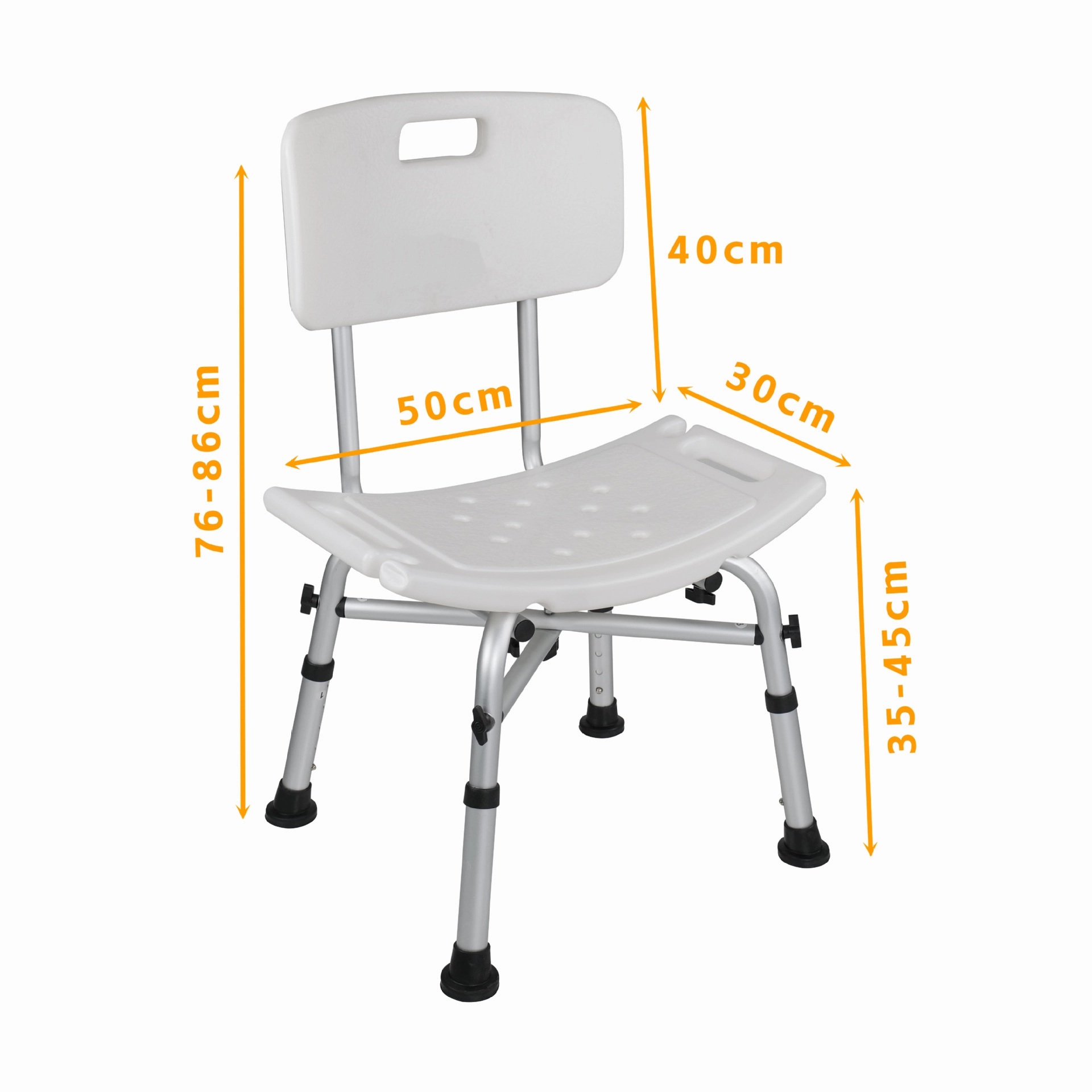
From a lifecycle perspective, adjustability delays functional obsolescence and supports consistent transfer mechanics even as physical conditions change.
Is backrest support essential, or can minimal stools be sufficient?
Why spinal stability, fatigue control, and psychological safety change bathing behavior and reduce accident probability
Backless stools assume that users maintain an upright posture effortlessly. In reality, prolonged sitting without support increases muscle fatigue in the lower back and abdomen, which leads to slouching, which shifts body weight backward and raises the chance of sliding. Backrests stabilize the trunk, distribute load, and reduce the effort required to remain seated. This improves relaxation and discourages sudden posture changes caused by discomfort.
Psychological security also plays a role. When users feel supported, movements become slower and more deliberate, which lowers accident probability.
How does product simplicity influence cleaning, hygiene, and infection control?
Why fewer joints, smooth transitions, and easy drainage improve long-term usability in home and institutional settings
Complex folding structures and multi-part assemblies trap moisture and soap residue. Over time, this leads to microbial growth and unpleasant odor, especially in warm environments.
Smooth surface transitions reduce cleaning time and allow effective disinfection. In institutional environments, where equipment may be shared, hygiene standards require fast drying and minimal contamination zones.
Besides, a simple structural layout also reduces the risk of mechanical failure due to corrosion or hidden material fatigue.
Can a lightweight design improve both safety and caregiver efficiency?
Why balanced weight, frame stiffness, and portability affect both caregiver handling and user confidence
Weight influences two user groups: the seated person and the caregiver.
A chair that is too heavy becomes difficult to reposition, increasing caregiver strain and the likelihood of accidental impacts against walls or fixtures, while a chair that is too light may feel unstable, reducing user confidence during transfer.
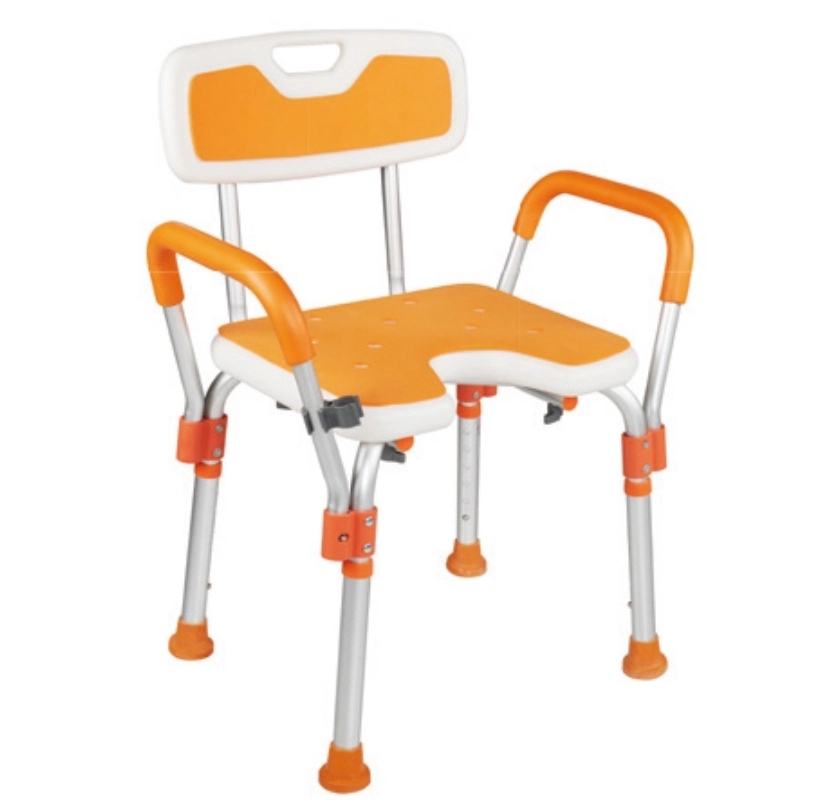
A balanced design approach is illustrated by the XY-798L bath chair. Optimized mass distribution and rigid frame construction allow stable seating while keeping handling manageable during cleaning or relocation. This dual benefit improves workflow efficiency and reduces physical burden across the care chain.
When does a shower chair become unsuitable despite appearing functional?
How surface wear, leg deformation, and hidden structural fatigue gradually increase risk over time
Material aging is subtle. Plastic becomes brittle, aluminum joints loosen, and anti-slip feet harden or detach. These changes are rarely visible during casual inspection.
A chair may appear intact while its structural safety margin has declined significantly. Regular assessment of leg alignment, seat surface integrity, and joint stiffness is necessary to prevent gradual risk escalation.
Why the best shower chair is defined by risk control, not by appearance
In bathing environments, safety emerges from controlled movement, predictable support, and structural reliability. A well-chosen shower chair minimizes unstable transitions, limits posture fatigue, and maintains performance across years of use.
Comfort features matter only when they reinforce biomechanical stability and hygiene efficiency, and visual design and accessory functions are secondary to risk containment.
When evaluated as safety infrastructure rather than bathroom furniture, the best shower chair becomes a long-term investment in autonomy, injury prevention, and care efficiency.
FAQs
Q1: Is a backrest truly necessary for most elderly users?
A: Yes. Backrests stabilize posture, reduce fatigue, and lower the frequency of sudden weight shifts, which directly decreases fall risk during bathing.
Q2: How often should a shower chair be replaced in long-term use?
A: Inspection every 6–12 months is advisable. Replacement depends on material aging, joint stability, and foot grip condition rather than calendar age alone.
Q3: Are higher load ratings always safer?
A: No. Dynamic stability, base friction, and frame geometry are more critical than static load figures during real transfer movements.


