

What Anti-Tip Wheels Do on a Wheelchair
Zeitpunkt: 19. Oktober 2026 Ansicht : 20

Wheelchair anti-tip wheels can approach the floor as a chair rotates backward, yet also catch at a ramp transition if the rear clearance is unsuitable. Both effects come from the same position behind the main rear wheels. Moving the part to solve one problem may change the protection it provides in another situation.
Rear anti-tippers limit backward rotation within the intended setup. They cannot make every route safe or protect against every direction of tipping. For a buyer comparing care wheelchairs, the useful question is how the device fits the frame and the route, rather than whether a small wheel is visible in a photograph.
What happens as the front casters lift
When a wheelchair begins to rotate backward around its rear axle, the front casters lift. Anti-tip wheels extend behind that pivot point. If the rearward angle continues, the small wheels meet the ground and can restrict further rotation. The system works only when the anti-tippers are present, correctly positioned, undamaged, and suitable for the chair configuration.
Contact with the ground does not guarantee that a complete tip will be prevented. The result depends on the wheelchair, the installed position, loading and the situation. Anti-tippers are one part of the stability arrangement, and any change to the setup needs the review specified for the chair.
Rear devices are not designed to provide comprehensive protection against forward or sideways tipping. They also do not correct a bent frame, unsuitable seating or unsafe handling. Sales descriptions should explain their direction of action instead of using a broad promise such as prevents falls.
Why ground clearance cannot be chosen in isolation
An anti-tipper closer to the ground generally contacts the surface sooner during rearward rotation. This can increase the margin before a full rear tip, but it reduces clearance under the rear of the chair. Ramps, curbs, thresholds, and vehicle loading equipment may then become harder to approach.
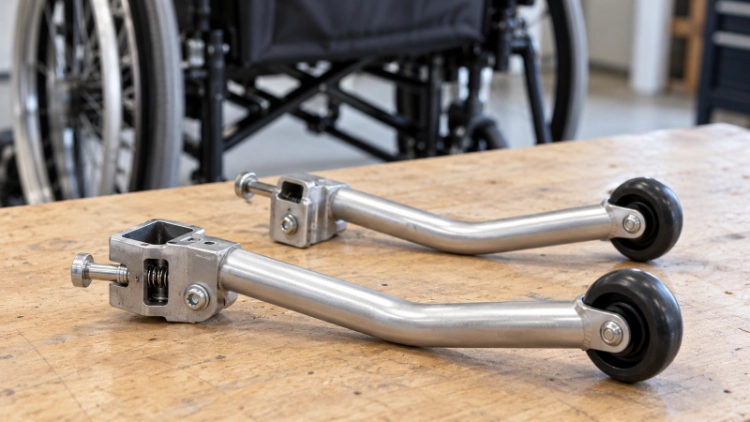
Some designs allow adjustment or temporary rotation out of the way. That flexibility adds responsibility. Staff must know the approved position for normal use and must restore it after loading, maintenance, or obstacle negotiation. A removable component that is left in a carton provides no support.
A route assessment should consider where surfaces meet. A threshold, the foot of a ramp and the transition onto loading equipment can each present a different clearance problem. A setting that clears one location is not automatically suitable everywhere else. Staff should report interference before changing the normal operating position.
Manufacturer guidance illustrates the distinction. The Sunrise Medical user manual warns that anti-tip tubes must not be treated as transit wheels for carrying an occupied chair after its main rear wheels are removed. Similar-looking small wheels can have different intended functions; an instruction for one cannot be transferred to another.
Changes elsewhere on the chair can matter
Rear wheel diameter, axle position, seat angle, backrest configuration, and attached equipment can change stability. Moving a rear axle forward can make propulsion easier on some active wheelchairs while also reducing rear stability. Adding a bag or other load behind the backrest can shift the center of mass. These changes require qualified review rather than guesswork.
A bag on the backrest is not part of an anti-tipper adjustment method. Its permitted location and load depend on the chair instructions. When accessories are added, the responsible clinician or equipment professional should consider the complete configuration rather than asking the rear devices to compensate for an unsuitable load.
For shared equipment in a Malaysian rehabilitation centre, record the approved position so that different staff do not leave the same chair in different states after transport. Any label or handover note should identify the model and relevant setting without concealing the locking mechanism.
A model example needs the complete frame context
The XY-C06-20 combines a folding aluminium I-beam frame with a toileting function and a pair of anti-tilt wheels. That configuration brings several operating tasks together. The presence of rear safety wheels does not, by itself, determine how the chair may be used during toileting, transfers or transport.
Other Xunyu Medical wheelchair configurations have different wheel sizes, backrests and folding mechanisms. A clearance or part selected for the XY-C06-20 should not be copied onto another frame merely because the fittings appear similar. Confirm the permitted device and position for the exact order.
Examine clearance with the wheelchair on a level floor and configured as supplied. Do not invent a universal acceptable height. Use the manufacturer’s specification and the approved assessment procedure. Check that the anti-tip wheels do not rub against rear wheels, brakes, folding parts, or other hardware.
There is no need to demonstrate a tip to judge whether the supplied parts are present and correctly attached. Any stability assessment or testing should use an approved procedure and competent personnel. An improvised occupied tipping test adds risk without providing a valid acceptance result.
Restore the operating position after handling
These small parts sit close to the floor and can be hit during loading or storage. Wheels may stop rotating, brackets may bend, locking buttons can stick, and removable units can be lost. A maintenance checklist should confirm presence, attachment, alignment, wheel condition, and the approved operating position.
If a design permits removal or rotation for transport, restoration belongs in the handover before the chair is released. Check that both parts are present where a pair is specified, that they are secured and that the approved normal-use position has been restored. Finding the parts in the storage bag is not the same as finding them ready for use.
A fault report to Xunyu Medizinische should include the whole side view of the chair as well as the affected bracket. A close photograph of a small wheel alone may hide the frame position or an accessory that is relevant to the enquiry.
Häufig gestellte Fragen
Q: Are wheelchair anti-tip wheels required on every manual wheelchair?
A: Requirements and clinical needs vary by wheelchair, user, service, and market. Anti-tippers may be appropriate for many configurations, but they are not a universal substitute for assessment. Buyers should follow the applicable product specification, professional recommendation, and local requirements.
Q: Why might anti-tip wheels catch on a ramp or threshold?
A: The wheels extend behind and below the frame. If they sit too low, the available departure clearance decreases, so they may contact a ramp transition or threshold. Adjustment must follow the wheelchair manufacturer’s instructions and should preserve the approved stability setup.
Q: Can anti-tippers be removed for transport?
A: Some designs are removable or can be rotated, while others are fixed. If removal is permitted, staff need a clear method for reinstalling and locking them in the correct position. A post-transport check should confirm that both sides are present and secure.
Before approving a wheelchair with anti-tip wheels, clarify the supplied device and its operating position. Include the intended care setting and any transport arrangements that may require permitted removal or repositioning.


