

How Crutches Quality Control Reduces Bulk Order Complaints
Time : Sep 07, 2026 Vista : 62
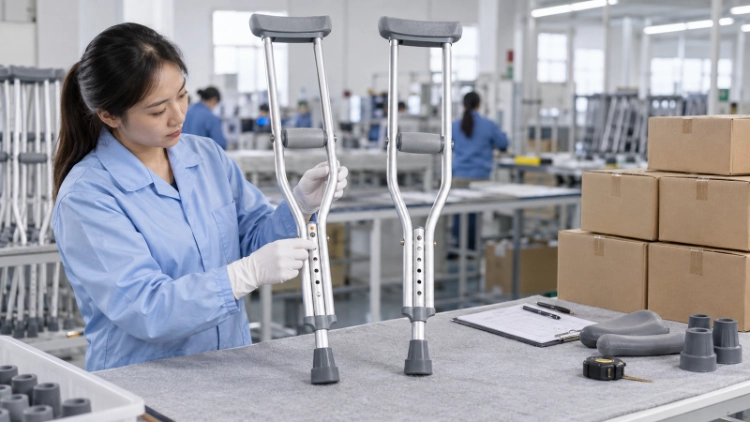
Bulk crutch complaints rarely begin with one dramatic failure. More often, a small mismatch is repeated across dozens of cartons: the wrong size label, a loose adjustment button, a damaged rubber tip, or instructions that do not match the model. For distributors in Malaysia, Singapore, and other Southeast Asian markets, that repetition can spread quickly through pharmacies, rehabilitation centres, and home-care channels. Crutches quality control should therefore begin before production and continue through receiving, delivery, and complaint handling. The aim is simple: every unit should be traceable to an approved configuration and every defect should lead to a clear action.
Why complaints begin before shipment
After-sales teams often see only the final symptom. A user reports an uncomfortable pad, a clinic receives two different sizes in one carton, or a dealer cannot identify the correct replacement tip. The cause may sit earlier in the order. The RFQ may have used a broad model description, the sample may not have represented every size, or the packing instructions may have omitted a clear carton mark. A general promise of good quality cannot correct these gaps. Buyers need product details that can be checked at each handoff.
The first control is an agreed specification. It should name the model, size mix, frame material, adjustment points, contact parts, finish, labels, manuals, accessories, and packing method. When several options are available, each option needs its own record. This prevents a later discussion from relying on memory or on a photograph of a different configuration.
Supplier responsibilities should be written into the same control plan. The crutches manufacturer should name who approves materials, labels, packing, and production changes. The crutches manufacturer should also keep the approved sample available for comparison. During sample review, adjustable crutches need repeated setting changes, and crutch pads need direct checks for attachment and damage. Complaint forms should retain the exact phrase crutches bruising armpits when that is how the distributor or user describes the symptom, while the investigation records the likely fitting or product cause separately.
Lock the approved crutch configuration
Record model size and adjustment details
El Muleta axilar de aluminio XY-925 is available in Small, Medium, and Large sizes. Its foot tube has nine adjustment levels, while the grip has five. Tube thickness options include 1.0 mm, 1.1 mm, and 1.2 mm. These details belong in the purchase order and sample approval record. Buyers should not assume that a change in tube thickness leaves the load rating, carton mark, quotation, or lead time unchanged. Those points need written confirmation for the selected configuration.
Define defects before inspection
A useful inspection sheet separates critical, major, and minor defects according to the buyer’s product risk policy. A broken or unreliable load-bearing connection would not be treated in the same way as a small finish mark. Major defects may include adjustment locks that do not engage, mixed sizes, missing instructions, or an incorrect rubber tip. Minor appearance issues can be recorded separately. The buyer and manufacturer should agree on the classification and acceptance limits before mass production, not after a shipment fails.
Use a sampling plan that matches the order
Checking two convenient cartons is not a sampling plan. Lot size, product risk, size mix, and previous supplier performance should guide the number of units inspected. ISO 2859-1 sampling procedures provide a framework for acceptance sampling by attributes, including single, double, and multiple sampling plans. The standard does not decide which crutch defects are acceptable. Buyers still need to define defect classes, inspection levels, and acceptance limits for the order.
Repeat the same functional sequence
Inspectors should set paired crutches to equal height and move adjustable crutches through several positions. Each spring button should return and seat fully. The grip adjustment should remain stable, and both sides should align at the selected setting. The test should cover every size or configuration represented in a mixed order. A surface check alone cannot confirm that an adjustment mechanism works after repeated use.
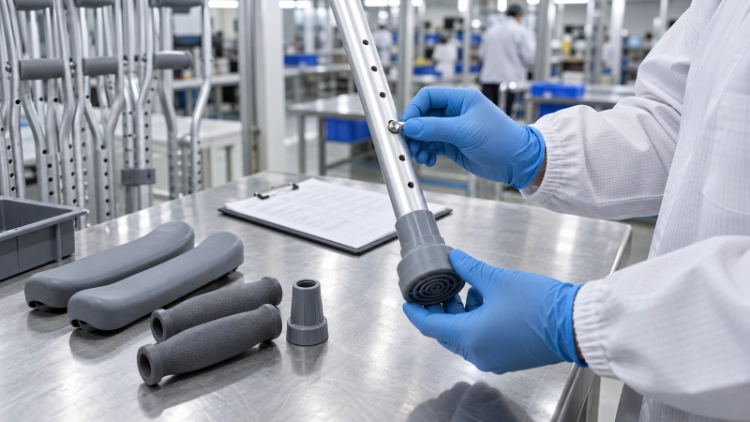
Check pads grips and rubber tips
Crutch pads, handgrips, and rubber tips need separate inspection lines. Check attachment, position, surface condition, flat floor contact, cracks, and early deformation. Use the approved part description for each model rather than a universal checkbox such as comfortable handle. The same rule applies to replacement parts. A spare tip is useful only when warehouse and service staff can match it to the correct model and size.
Match cartons labels and instructions
Carton marks should identify the model, size, quantity, and configuration clearly enough for receiving staff to separate stock. Compare the packed unit with the approved sample and confirm that the manual belongs to that design. Instructions for a forearm crutch should not be reused for an underarm model. Packing should also protect pads, grips, and tips from compression or rubbing during transport.
Investigate complaints by part and batch
Handle underarm bruising reports carefully
The phrase crutches bruising armpits may describe poor fitting, incorrect grip height, pad damage, or improper weight placement. It does not prove that the whole batch has a structural defect. Request the model, size, adjustment position, photographs, carton mark, and instructions supplied with the unit. MedlinePlus crutch guidance advises users to carry weight through their hands rather than their armpits and to have crutches adjusted to their height. Distributors should direct fitting questions to qualified healthcare guidance while continuing to investigate possible product defects.
Separate wear from delivery defects
A cracked tip found on receipt is different from normal wear after months of use. Complaint records should distinguish damage on arrival, missing parts, adjustment faults, contact-part wear, incorrect labels, fitting questions, and requests for spares. This keeps product quality issues separate from use and maintenance questions. It also gives purchasing teams cleaner evidence when they review a manufacturer.
Turn complaint records into corrective action
Every case should include the order number, model, size, batch or carton mark, affected part, reported symptom, photographs, date, and quantity. The record should also name the action taken. A warehouse problem may require relabelling and a stock check. An adjustment fault may require screening the remaining batch and obtaining a manufacturer response. A missing manual may call for document correction before more units are released.
Close the case only after the action has been checked. Record whether the unit was replaced, a spare part was supplied, other stock was inspected, or packing and instructions were changed. Reviewing repeated complaint codes each month can reveal whether an issue is isolated or linked to one configuration. Buyers can then adjust the next sample approval and incoming inspection plan.
Related models and contact-part options can be reviewed in the Xunyu Medical crutch range. Product availability and replacement-part terms should still be confirmed for the exact order.
Conclusión
Reducing complaints in bulk crutch orders depends on traceability and repeatable checks. Lock the configuration, define defect classes, select a sampling plan, test adjustment functions, match labels and manuals, and code every complaint by model and batch. This creates a crutches quality control process that purchasing, warehouse, and after-sales teams can use together. It also makes corrective action more specific than a broad request to improve quality.
Southeast Asian distributors can send the size mix, inspection points, packaging needs, and spare-part questions when they Contacte con Xunyu Medical about a bulk crutches order.
Preguntas frecuentes
Q1: What should buyers confirm before approving bulk crutch production?
A1: Confirm the exact model, size mix, material option, adjustment points, contact parts, labels, manuals, accessories, and packing method.
Q2: How many crutches should be checked in a bulk order?
A2: Use an agreed sampling plan based on lot size, product risk, size mix, and inspection history. Every configuration in a mixed order should be represented.
Q3: What after-sales checks matter for Southeast Asian distributors?
A3: Track adjustment faults, mixed sizes, damaged contact parts, missing documents, packaging damage, and spare-part availability by model and batch.


