

Importing Electric Wheelchairs into Southeast Asia
Time : Oct 02, 2026 Vista : 67

A quote for an electric wheelchair needs more detail than a model name and a unit price. Which battery comes with it? Is the charger the one supplied with the sample? Does the quoted weight include the accessories? For a dealer importing electric wheelchairs into Southeast Asia, these questions affect the buying decision before freight or local sales enter the picture.
The sample is a useful place to start. Its frame, motor arrangement, battery and charger give the buyer something definite to price and review. A second quotation becomes easier to assess once the differences are visible. If one includes a smaller battery, the two offers are no longer for the same package, however similar the chairs look.
What changes between the two XY-D02L versions
A chair used inside a building presents a different handling problem from one lifted into a car every day. At the car, someone has to fold it, reach a suitable lifting point and clear the opening. A compact chair can still be difficult to lift if the person handling it cannot find a comfortable grip.
The aluminum and carbon-fiber XY-D02L configurations from Xunyu Médico illustrate why the full version belongs on the order. In the aluminum configuration, nominal net weight is 21 kg, with two 250 W brushed motors. The carbon-fiber configuration has two 150 W brushless motors and a nominal net weight of 15 kg.
There is a six-kilogram difference between those net weights. A sample trial can show whether that difference makes loading easier for the person doing it. The carbon-fiber version also has lifting armrests and a quick-detachable battery box for separate charging. Motor wattage alone does not settle which version suits the intended user; the chair’s operating limits and the user’s needs remain part of the selection.
Space for the chair and space for the carton
El XY-D02L Pure Carbon Fiber wheelchair folds to 56 × 29 × 78 cm. That is the measurement relevant to a vehicle opening or storage space. The packed unit measures 58 × 38 × 83 cm and has a nominal gross weight of 17 kg, so a freight calculation uses a different set of figures.
The quotation should also identify the battery and accessories included in the stated weight. The battery option needs to be clear when comparing weights.
Choosing a battery before quoting a travel distance
The carbon-fiber configuration has 6 Ah, 10 Ah and 20 Ah lithium battery options, with nominal travel-distance ranges of 6–10 km, 10–15 km and 15–25 km respectively. A dealer comparing these options needs the test load and surface behind the figures. Otherwise, the distance printed in a sales leaflet has little context for the customer’s actual route.
Charging access also affects the choice. Can the user charge between journeys? Will somebody remove and carry the battery? Those details help decide whether the larger option addresses a real need. Its price, handling and replacement supply still belong in the order discussion.
A customer will eventually need to know which replacement fits the chair, not just how far the original pack might travel. Recording the selected battery model at purchase gives the service team a starting point when that enquiry arrives.
Battery information for the freight booking
The forwarder needs to identify the actual pack. An Ah figure leaves out voltage, while a description such as “lithium battery” leaves out the model. Chemistry, rated voltage and the Wh rating therefore belong with the battery designation in the shipping information.
Wh can be calculated from the rated voltage and capacity. For example, 24 V multiplied by 10 Ah gives 240 Wh. This calculation is an example, not a battery specification for every wheelchair. The shipping record needs the ratings of the pack ordered, together with how it will be packed.
Whether the battery remains installed, travels alongside the chair or ships separately is a question for the booking, not a decision to leave until packing day. The applicable UN 38.3 test summary also needs to identify the supplied battery. When a document names another pack, the discrepancy needs resolving before the forwarder can rely on it.
For air freight, IATA’s lithium-battery shipping guidance is a useful reference for testing and transport considerations. Classification, packing, marking and documentation still depend on the actual consignment and current requirements. Sea shipments need review under the applicable maritime dangerous-goods rules.
Passenger travel can cause confusion here. A customer’s arrangements for taking a mobility aid on a flight are separate from importing stock as cargo. A removable battery or folding frame does not settle either booking. An “airline approved” description needs evidence and clear acceptance conditions.
The charger supplied with the order
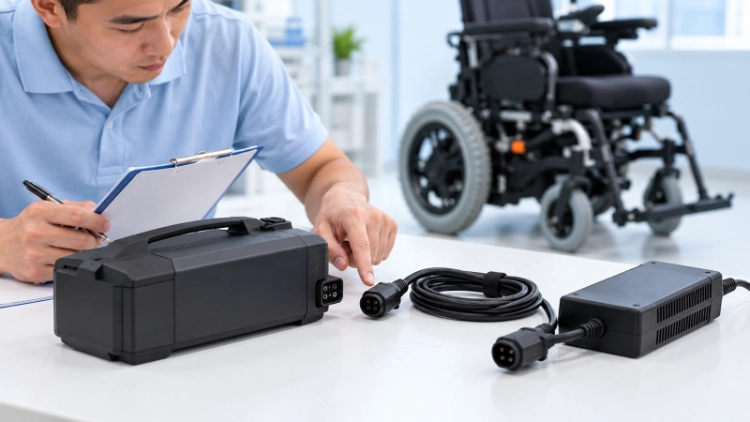
Receiving staff can compare a charger label and connector with the approved sample photographs. The details to record include input voltage and frequency, output voltage and current, plug type, connector and the approved battery pairing. A plug adapter addresses the physical connection to a socket; it cannot establish that the charger suits the battery.
If a customer later loses a charger, a photograph alone may not be enough to order the replacement. The service team needs its approved part number and compatibility details. Without it, someone may suggest buying a similar-looking unit locally. A later change of battery option should also trigger a review of the charger pairing.
Preparing stock for Singapore or Malaysia
A Singapore order and a Malaysian order can use the same specification format. Each still needs its own destination review. The local importer or regulatory adviser needs to assess the selected wheelchair’s classification and the registration, licensing, labelling and sales obligations that apply to the business arrangement.
This is easier while the supplier can still adjust the order. A company certificate or evidence relating to another product cannot establish permission to sell the selected wheelchair. The supporting evidence needs the correct model coverage, issuer, validity and scope.
The packaging artwork needs attention too, particularly with a distributor’s own branding. Staff should be able to connect the retail label to the chair, battery and charger in the service record. Language versions and local labels belong in the approval process before printing.
A dealer considering the electric and manual wheelchair collection can use customer handling needs to narrow the initial range. The aluminum and carbon-fiber options give different starting points for that discussion. Actual quotations, minimum order quantities and lead times then determine what is practical for the first shipment.
After delivery
A replacement controller or joystick needs a more precise description than “for the XY-D02L.” The original configuration record helps identify the right part. Batteries, chargers, wheels and folding components need the same attention. Compatibility, prices, warranty boundaries, minimum quantities and delivery terms are matters for agreement with the supplier.
For a technical enquiry, Xunyu Medical’s product support can be given the model, serial or batch reference, photographs and a fault description. Local staff also need a clear boundary between permitted checks and repairs requiring authorised support. This is particularly useful when two versions share a similar model name.
The approved sample provides the reference for receiving inspection. Battery and charger identities, controls, brakes, armrests, folding operation and included accessories can be compared under the manufacturer’s instructions. Any mismatch needs a record before stock reaches customers.
Conclusión
A complete configuration record keeps purchasing, freight and service discussions connected. It should follow the order from sample approval through delivery. To build a destination-ready wheelchair quotation, share the country, sales channel, preferred battery option and expected quantity, along with the handling needs that matter to the intended customers.
Preguntas frecuentes
Q: Which battery documents should an importer request?
A: The applicable UN 38.3 test summary should identify the battery being supplied. Its model, chemistry, voltage, Ah and Wh ratings also belong in the shipping information. The forwarder needs the packing arrangement and transport mode to determine any further documentation and declaration requirements.
Q: Can the same import checklist cover Singapore and Malaysia?
A: Model specifications and sample records can share a format. The destination-market review needs to be separate, including applicable classification, registration, labelling and business obligations. Language and charger requirements also need to be agreed for each order.
Q: How should distributors compare wheelchair range figures?
A: Start with the exact model and battery option, then look at the test load, surface and other conditions. Charging access and replacement support affect the purchase as well. Nominal distance helps compare configurations; actual travel distance will depend on the user’s conditions.


