

Quick-Release Wheels on Wheelchairs Explained
Time : Oct 13, 2026 Vista : 22
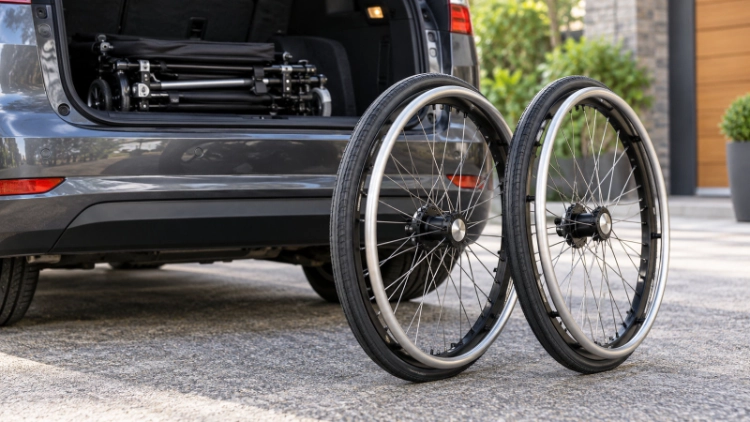
A wheelchair rear wheel can slide onto its axle and still be incompletely locked. The button may look almost right, while the locking elements have not engaged with the receiver. That makes reinstallation the most important part of a quick-release wheelchair wheel demonstration, especially when a family member will remove the wheels for transport.
A quick-release system usually allows wheel removal without ordinary hand tools. Folding and wheel removal are separate features: a chair may fold while its wheels stay attached, or have removable wheels on a frame that does not fold sideways. The transport benefit depends on the complete chair.
Follow the connection from the button to the frame
In a common design, pressing the axle button retracts small locking elements near the axle end. The axle can then slide into or out of the receiver on the wheelchair frame. Releasing the button allows the locking elements to extend again. The user or technician should confirm that the axle is fully seated and that the wheel cannot pull free.
Different manufacturers use different dimensions and mechanisms. Axle length, receiver size, bearing arrangement, and wheel hub must match. A quick-release axle should never be treated as a universal spare part because it looks similar in a photograph.
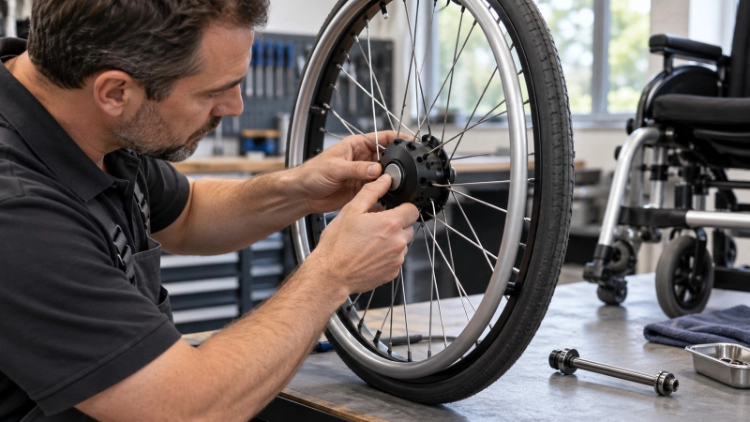
The receiver is as important as the axle. If its position or the matching hardware changes, a previously suitable wheel may no longer seat as intended. A wheel of the same diameter is therefore not necessarily a compatible replacement. The hub, bearings and axle arrangement need to remain the approved combination.
A practical manufacturer example is the QUICKIE 5R quick guide, which includes insertion, release of the button and an outward pull to confirm locking. That guide applies to its own wheelchair. It illustrates why the supplied model’s instructions must define the check, rather than leaving users to judge engagement by appearance.
Demonstrate reinstallation with the chair unoccupied
Wheel removal and fitting should take place with the wheelchair unoccupied and safely supported according to its instructions. Staff need to know how to support the frame before releasing a wheel. A demonstration that starts after the wheel is already detached leaves out a step the customer still has to perform at home.
The first check is functional. With the chair unoccupied and supported as instructed, remove and reinstall the wheel. After the button returns to its normal position, pull outward on the hub using the approved method. The wheel should remain securely engaged. It should rotate freely without excessive side play or contact with the frame or brake.
The axle should be clean and free from visible bending, corrosion, deep scoring, or damaged locking parts. The receiver should also be inspected. Lubrication, cleaning, and adjustment must follow the manufacturer instructions because the wrong product can attract dirt or change the locking action.
If the button does not return, or the wheel does not remain secure during the prescribed check, stop the handover. Do not ask the customer to compensate by pushing harder, adding a spacer or changing an adjustment. The responsible technician should identify the cause using the manufacturer’s procedure.
Sample approval should include several removal and installation cycles. Check both sides, because one axle may behave differently from the other. Record button return, pull-test result, wheel rotation, side play, brake clearance, and any visible damage. If an inspection method or force is specified, use the supplier’s documented value rather than inventing one.
For a retailer serving home-care customers in Singapore, the person learning this sequence may be an adult child rather than the wheelchair user. Allow that person to repeat the approved process while staff observe. Written instructions are still needed for later reference, particularly if transport is infrequent.
Measure the transport arrangement after the wheels are removed
Large rear wheels contribute a substantial part of a manual wheelchair’s external width and height. Removing them can make the frame easier to place in a vehicle. The benefit depends on the remaining frame dimensions, wheel weight, footrest design, backrest folding, and the lifting ability of the person handling the chair.
A quick-release feature does not automatically make a wheelchair lightweight. Manual wheelchair models differ in net weight, rear-wheel diameter, folding frame design, removable footrests, and backrest systems. Buyers should compare the complete transport sequence, not one component.
Separate measurements are useful for the remaining frame and the detached wheels. The largest item may still be difficult to lift, even though the assembled wheelchair now occupies less space. Check the actual vehicle opening and storage position instead of assuming that wheel removal makes every chair suitable for a small boot.
El Sillas de ruedas médicas Xunyu covers several wheel and folding formats. A quick-release rear-wheel requirement needs explicit confirmation for the proposed model. A photograph of a large rear wheel, a folded frame or a handrim does not establish that the axle can be removed without tools.
Protect and identify the detached wheels
Once removed, wheels can be scratched, contaminated, misplaced, or damaged around the axle button. A transport bag or protected storage position may be useful. Staff should avoid placing weight on the axle end or allowing debris to enter the locking mechanism.
Receiving and rental operations also need a matching process. Each frame must be reunited with the correct wheels. Model or asset labels can reduce mix-ups when several similar chairs are handled together.
Keep any supplied axle protection or storage instructions with the chair. Labels used to identify an equipment set should not cover the button, interfere with the hub or obstruct inspection. Where several rental chairs return together, the frame and its approved wheels need to remain traceable throughout cleaning and storage.
Check what changed when the wheel was refitted
A secure wheel also needs to rotate as intended. Brake rubbing, unusual side movement or a changed gap deserves attention even when the axle resists the prescribed pull check. Correct retention and correct wheel operation are related checks, but neither substitutes for the other.
Side wheel locks should be checked after reinstallation using the supplied instructions. Their stationary holding function can be affected by wheel position or a changed tire. A quick-release feature does not turn a parking lock into a brake for slowing a moving chair.
Before placing an order with Xunyu Médico, ask whether the requested removable-wheel configuration is available and which documentation accompanies it. If it is not confirmed, compare the chair on its actual folding and transport features rather than advertising an unverified option.
Preguntas frecuentes
Q: Do all folding wheelchairs have quick-release wheels?
A: No. Many folding wheelchairs keep their rear wheels attached when the frame closes. Quick-release wheels are a separate feature that must be stated in the model specification. Folding and wheel removal may both reduce transport size, but they use different mechanisms.
Q: Can any wheelchair wheel be converted to quick release?
A: Conversion depends on the frame receiver, hub, bearings, axle dimensions, brake position, and manufacturer approval. A similar-looking axle is not proof of compatibility. Buyers should use parts and conversion instructions approved for the exact wheelchair model.
Q: What spare parts should buyers request for a quick-release system?
A: Request the approved axle, wheel or hub assembly, bearings, spacers, receiver parts, and any model-specific tools or instructions. The exact list varies. Part numbers and compatible model codes are more reliable than ordering by wheel diameter alone.
For a range that requires quick-release wheelchair wheels, send the intended transport arrangement for review. A useful enquiry identifies the proposed frame and asks for the matching wheel, axle and locking instructions together.


