

Bringing Crutches on a Plane A Guide for Distributors
Time : Sep 09, 2026 Vue : 63

Passengers can usually bring crutches on a plane, but the exact screening and stowage process depends on the route, airline, aircraft, and local rules. That direct answer matters because travellers often search for a simple yes or no. Mobility aid distributors serving Malaysia, Singapore, and other Southeast Asian markets should give customers verified product dimensions, weight, adjustment details, and packing guidance, then direct them to the operating carrier for route-specific confirmation. A product should be described as travel-friendly only when its measurable features support that claim.
Can passengers bring crutches on a plane
For flights to, from, or within the United States, the US Department of Transportation stowage guidance identifies crutches as assistive devices permitted in the cabin. Assistive devices have priority for available in-cabin storage over other items brought aboard at the same airport when the passenger preboards, but they still need to fit and be stowed safely. If cabin space or safe stowage is not available, the carrier may place the device in the cargo area.
Security screening is a separate step. The TSA guidance for crutches allows crutches in carry-on and checked baggage, while mobility aids must go through the applicable screening process. These US rules should not be presented as worldwide rules. Passengers travelling elsewhere should check the departure airport, destination requirements, and airline procedures before departure.
A distributor should avoid broad claims such as airline approved or guaranteed cabin storage. Airlines may use different aircraft on the same route, and storage space can change. Sales staff can state the model name, open and folded dimensions where applicable, unit weight, removable parts, and packing method. The carrier then decides how the crutch will be handled on the specific journey.
Turn travel questions into product data
Measure the exact model
Travel crutches should be described with numbers, not only adjectives. Record open length, folded length for a folding design, widest point, net weight, gross weight, and carton dimensions. Note whether cuffs, pads, tips, or accessories can be removed and how they are protected. Measurements must belong to the exact size and SKU. A dimension borrowed from a similar model can create problems at check-in or during a transfer.
Lightweight crutches may be easier for a traveller or caregiver to carry, but material alone does not prove portability, strength, or suitability. Buyers should compare the complete unit at the selected size. A long adjustable underarm crutch may be light but difficult to stow, while compact foldable crutches may need additional inspection at the joint and locking point.
Check folding and adjustment functions
Foldable crutches need a clear opening and closing sequence. The joint should reach its intended open position without damaging the handgrip or rubber tip during storage. For a foldable forearm crutch such as XY-937, buyers should confirm the folded dimensions, packing arrangement, and locking method before using it in a travel range. Those details should come from the approved model and current quotation.
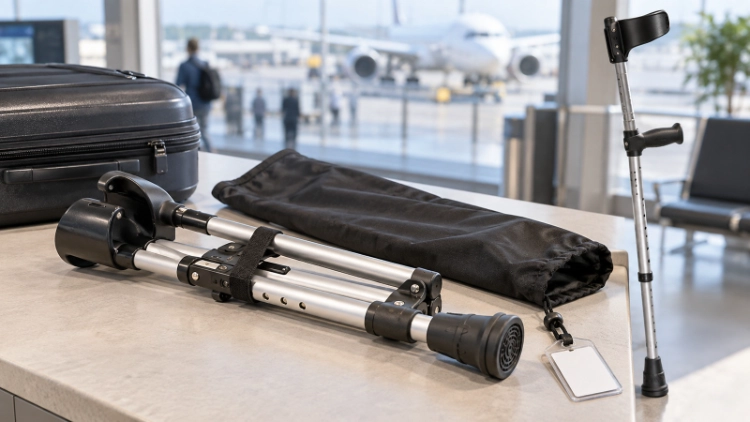
Adjustable crutches require a different set of checks. The XY-925 underarm crutch comes in Small, Medium, and Large sizes, with nine foot-tube settings and five grip settings. These features help a distributor build a broader size range, but they do not make one unit suitable for every traveller. A qualified person should confirm fit, and the user setting should be recorded before the journey.
Protect the crutch during handling
A travel product can function correctly and still arrive with a damaged contact part. Packing should prevent rubber tips, pads, cuffs, and handgrips from rubbing against adjustment tubes or carton edges. A folded unit should not move freely inside the box. If a crutch is handed to airline staff, a simple sleeve or protective wrap can reduce scuffs and keep loose accessories together, provided it does not prevent security inspection.
Labels should identify the passenger or owner as well as the model when the device may be handled away from the seat. Distributors can supply a removable identification tag and a short product information card. The card can include open and folded dimensions, unit weight, adjustment method, and a photograph of the correct open position. It should not claim that every airline will accept the device in the cabin.
Build a travel range for different channels
A mobility aid supplier may serve several travel-related channels. Pharmacies may need adjustable crutches for customers recovering before a trip. Rehabilitation providers may prefer models with detailed fitting information. Hotels, airports, and care programmes may focus on simple handling, visible size labels, and fast replacement of worn tips. A distributor should map each model to a real channel instead of labelling the whole catalogue as travel products.
Current options can be compared through the Xunyu Medical crutch range. Before listing a model as travel-friendly, confirm that it is currently available and obtain the exact weight, dimensions, joint or adjustment details, packing method, and replacement-part terms.
For Southeast Asian distribution, the information sheet may also need local-language fitting notes and contact details for regional support. Singapore channels may value compact storage in clinics, apartments, and retail outlets. Malaysian buyers may need practical packing for dealer distribution and home-care use. These situations help define the sales materials, but they do not replace carrier confirmation for an individual flight.
A mobility aid supplier should also separate travel claims from ordinary catalogue language. Lightweight crutches need verified weight and size data for each version, while standard models may be suitable for local home care without being practical for frequent flights. This distinction helps sales teams describe benefits accurately and gives buyers a clearer reason to carry more than one model.
Give travellers a clear handoff sheet
The passenger information sheet should answer the questions most likely to arise before departure. State whether the design folds, how it opens, where the locks are, which parts are removable, and how to restore the recorded height. Include the model, size, dimensions, and weight. Remind the passenger to contact the airline, request any needed assistance, and allow time for screening.
The same sheet can help after handling. A small diagram can show a fully engaged spring button or the correct open position of a folding model. Add a check for cracks, loose parts, and tip damage before the device is used again. Medical instructions should remain with the passenger’s healthcare provider. The distributor’s role is to provide accurate product information and a clear route for replacement parts.
Questions buyers should ask the supplier
Ask for net and gross weight, open and folded dimensions, size range, adjustment levels, joint and lock details, carton size, included accessories, manual version, and photos of open and stored positions. Confirm whether tips, grips, pads, or cuffs can be ordered separately. If the model will be sold in several countries, keep country-specific airline statements out of general product claims.
Distributors can send the target route, channel, size mix, documentation needs, and packaging questions when they Contactez Xunyu Medical about travel-friendly mobility products.
Conclusion
Bringing crutches on a plane is possible in many situations, but safe screening and stowage still depend on the route and carrier. Distributors should give customers a direct answer, explain the regional rule boundary, and provide facts for the exact model. Verified dimensions, weight, folding or adjustment details, protective packing, and a passenger information sheet make travel crutches easier to discuss without promising universal airline approval.
The wider product portfolio from Xunyu Médical can support buyers building a travel and home-care mobility range, subject to model-specific confirmation.
Questions fréquentes
Q1: Do crutches count as carry-on baggage on US flights?
A1: Assistive devices do not count against the passenger’s carry-on limit under US DOT rules, but the crutches must be stored safely and available cabin space still matters.
Q2: Do crutches need airport security screening?
A2: Yes. TSA procedures require walkers, crutches, canes, and other mobility aids to undergo the applicable screening process.
Q3: What should Southeast Asian travellers confirm before flying?
A3: Check the airline, departure airport, destination rules, aircraft handling process, and any assistance request. US guidance should not be assumed to apply to every route.


