

Rotating Shower Chair Design: What Should Buyers Check Before Selecting a Model?
Time : Nov 03, 2026 Visualizzazione : 33
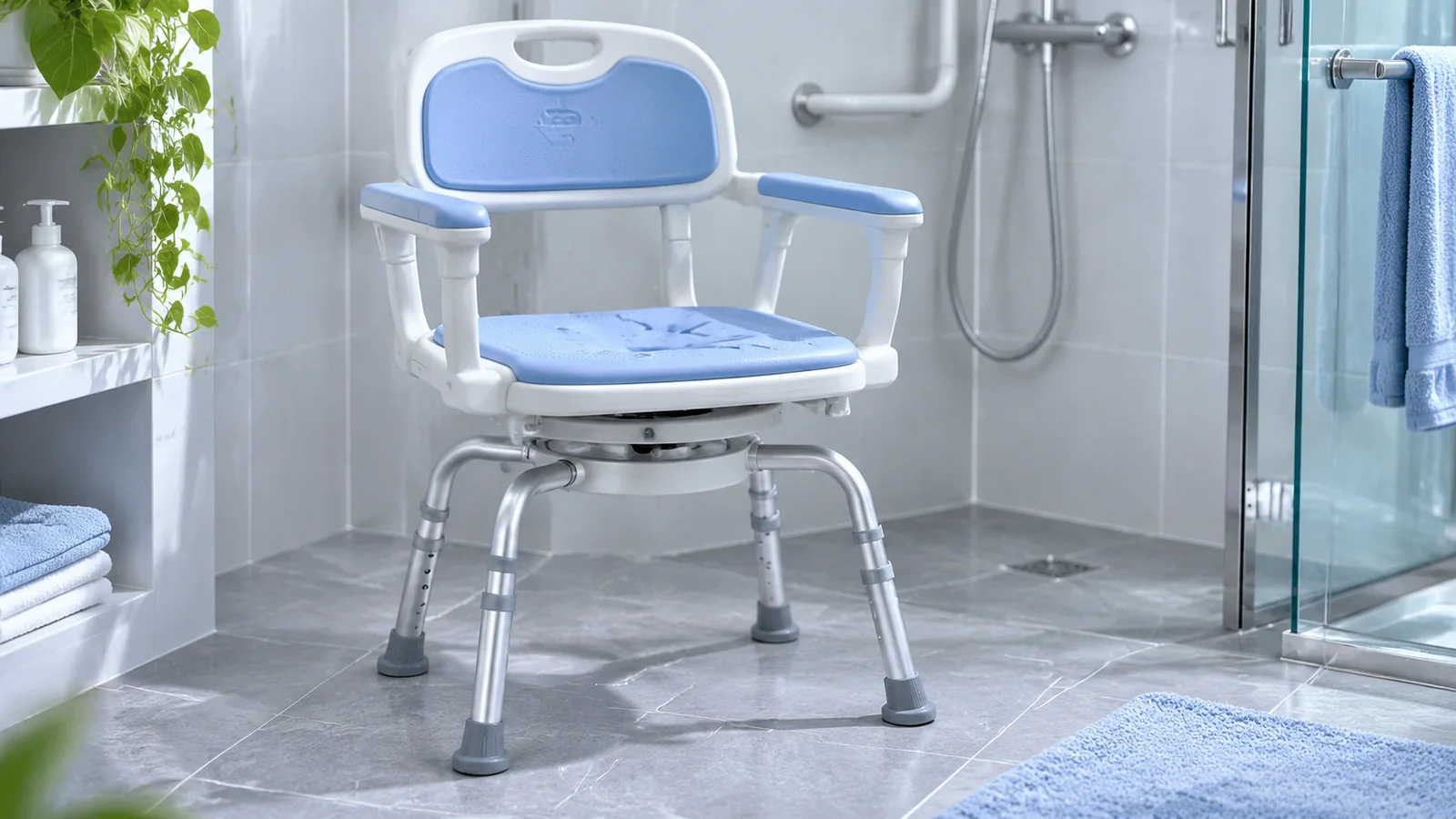
A rotating shower chair is selected for a specific reason: it can change the direction in which a seated user faces without requiring the whole chair to be repositioned. For distributors and care-equipment buyers, that function raises several practical questions. How is the seat supported? Does the mechanism lock in defined positions? Can the chair fit the available bathroom space? Are the legs adjustable, and can the assembly be checked easily after delivery? A product description that says “rotating” does not answer these questions. The mechanism, frame, seat, adjustment points and installation instructions all need to be reviewed as one product.
How Does a Rotating Shower Chair Work?
A rotating bath chair uses a seat or seat assembly that turns relative to its supporting frame. The exact construction varies by model. Some designs use a central swivel connection beneath the seat, while others use a transfer-style arrangement with a more substantial support structure. Buyers should confirm the movement range and the way the seat is held in position from the manufacturer’s documentation. A rotation feature should never be assumed to include an automatic lock, a particular number of stopping positions or a transfer function unless those details are specified for the model.
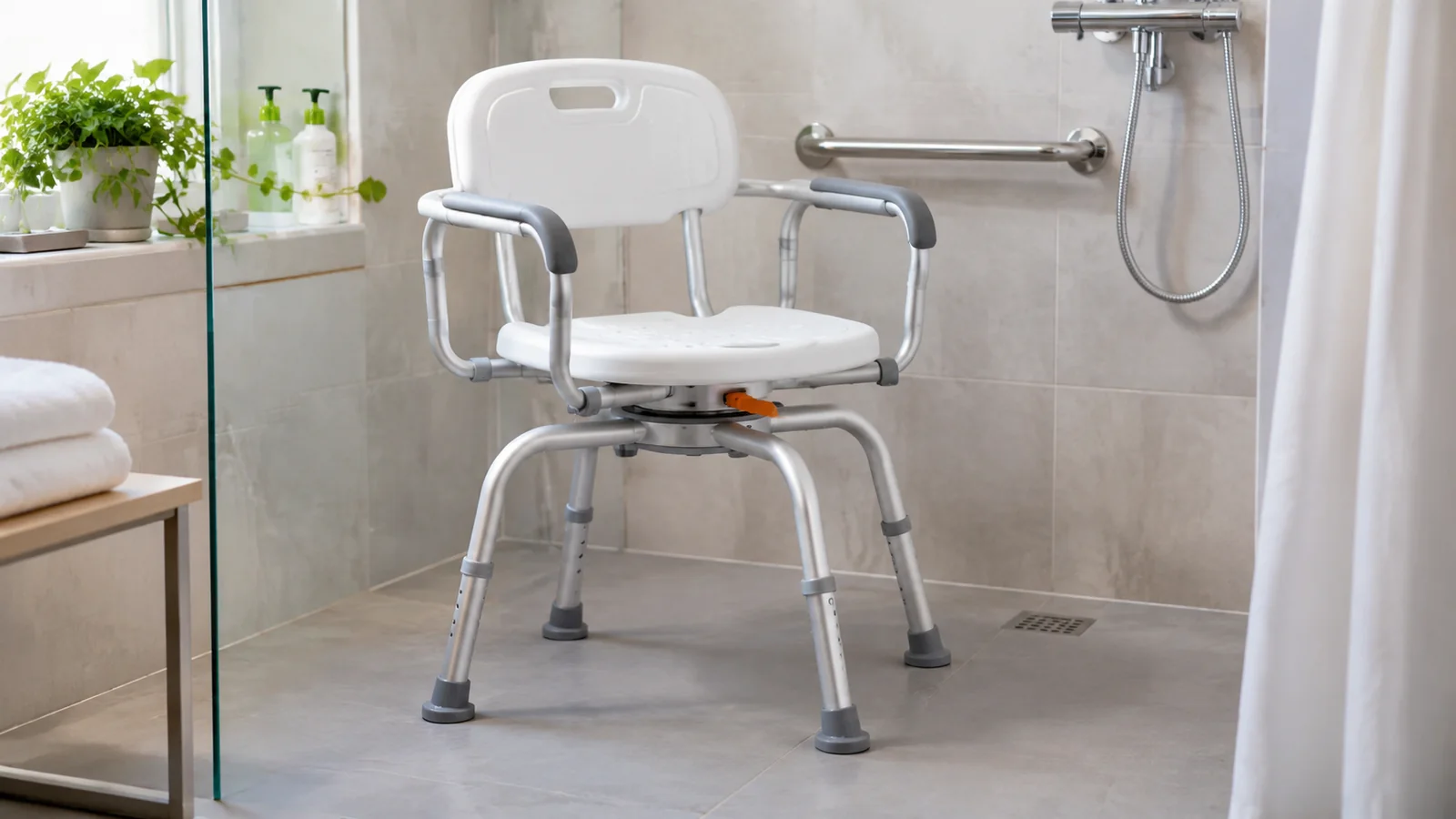
The seat and its supporting connection
The seat connection transfers force into the frame. Inspect the sample for loose fasteners, uneven movement, visible gaps or rubbing parts. Smooth rotation alone is not enough: the seat must remain supported in its intended positions. Ask the supplier to identify moving and fixed components so warehouse and service teams can distinguish normal movement from a defect.
Rotation control and position security
Before adding the model to a catalogue, confirm how the seat is controlled. Check whether the user or caregiver operates a lever, release or pin, and whether rotation is continuous or limited to set positions. Do not claim a locking function, one-handed operation or transfer assistance unless the model instructions confirm it. Rotation does not remove the need for supervision or an appropriate transfer assessment.
Which Design Details Matter in a Rotating Shower Chair?
A rotating seat is only one part of the product. Buyers also need to review the contact surfaces, frame geometry and floor interface. These details affect whether the product can be positioned in a particular bathroom and whether its specifications can be explained accurately to a distributor’s customers. A useful comparison sheet records each feature separately rather than combining them into a broad statement such as “safe and comfortable design.”
Seat shape, surface and user contact points
Check the usable seat area, drainage openings where present, edge shape, back support and armrest arrangement. A contoured or perforated surface may assist water drainage, but its presence does not establish a particular hygiene outcome. If a seat has a removable cover or cushion, confirm how it is attached and whether replacement parts are available. Armrests should be assessed for grip shape, clearance and attachment strength. Buyers should also request the seat dimensions and distinguish them from the overall footprint of the chair.
Frame material, leg adjustment and floor contact
The XY-799-2 bath chair has an oxidised aluminium frame, six height settings, a removable structure and non-slip feet. Its seat height adjusts from 33.5 to 46.5 cm in 2.5 cm increments. Net weight is 1.6 kg and gross weight is 2 kg. These are model-specific details, not universal specifications for rotating shower chairs.
What Should Buyers Check Before Selecting a Model?
The right selection process starts with the intended bathroom layout and the user group served by the buyer’s channel. A compact home bathroom, a shared care facility and a distributor showroom may impose different space and handling requirements. Before approving a model, compare the chair’s overall dimensions with the available clear floor area, shower opening, drainage position and route used to bring the chair into the room. Do not use seat width as a substitute for the full footprint.
Dimensions, assembly and installation
Request a dimensioned drawing that identifies seat width and depth, seat-height range, leg spacing and total footprint. Confirm whether the chair arrives assembled or requires installation, and list the included fasteners or tools. For the XY-799-2, the listed carton dimensions are 42.5 × 34.5 × 11 cm for one piece and 38 × 44.5 × 63.5 cm for five pieces. Use the carton size that matches the actual order quantity when planning freight and warehouse space.
Cleaning, inspection and replacement parts
Shared-use settings need a clear cleaning procedure and a repeatable inspection routine. Ask which cleaning agents are compatible with the seat, frame finish, fasteners and rubber feet. The product manual should be followed rather than assuming that strong disinfectants or high-pressure washing are suitable. Buyers should also ask whether rubber feet, seat components, adjustment pins and other wear parts can be ordered separately. A supplier’s answer should identify the relevant model and part reference, not simply state that spare parts are available.
How Can Distributors Evaluate a Rotating Bath Chair Supplier?
Supplier review should connect the sample with the specification that will govern the order. Record the model code, seat configuration, frame finish, six-position height adjustment, included accessories, carton specification and instruction revision. If a product photograph shows a different seat or armrest from the quotation, resolve the difference before sample approval. This is particularly important when similar bath-chair models use different seat or adjustment arrangements.
The XY-799-2 provides 360-degree seat rotation, six height settings and an oxidised aluminium frame. Its seat height adjusts from 33.5 to 46.5 cm in 2.5 cm increments. The listed net and gross weights are 1.6 kg and 2 kg. Before listing the model, buyers should obtain a confirmed rated-load figure from the supplier rather than infer one from the frame or seat.
For buyers comparing bathroom aids across a wider range, Xunyu Medical’s gamma di sedie da bagno can be reviewed alongside other elderly-care products.
For the selected model, compare the seat height range and leg spacing with the bathroom layout before deciding whether the product fits the intended channel.
The company supplies elderly assistive devices for overseas distributors and care-equipment channels. Xunyu Medico serves buyers reviewing products for these markets.
Any requested change should be tied to a model code and a dated sample record. This keeps the approved version clear when the order is repeated.
For private-label projects, define the requested changes, identify the model version and approve a reference sample before production. Available cooperation options can be discussed through the company’s ODM/OEM service information.
The final product file should identify the seat, frame, adjustment points and included accessories separately, rather than grouping them under a general safety claim.
A rotating shower chair should be assessed as a complete bathroom aid, not simply as a seat with an extra feature. Buyers comparing models can send the intended application, required dimensions and target configuration to contact Xunyu Medical for product details.
Domande frequenti
Q: What is the difference between a rotating shower chair and a fixed shower chair?
A: A rotating model has a seat or seat assembly designed to turn relative to its frame. A fixed model keeps the seat in one orientation. The exact rotation range and any locking positions depend on the individual product specification.
Q: Does every rotating shower chair lock in place?
A: No. Buyers should confirm the locking or position-control mechanism in the model’s instructions. The word “rotating” alone does not prove that the seat has a lock or a specific set of stopping positions.
Q: Which dimensions should distributors request?
A: Request seat width and depth, seat-height range, overall footprint, leg spacing, package dimensions and net and gross weight. The drawing should show where each measurement is taken.


