
Bed Assist Rails for Nighttime Bathroom Trips: What Makes Getting Out of Bed Safer?
日時:2026年6月15日 視聴数 : 34
For many care teams, the riskiest bedroom movement is not a long walk. It is the repeated action of sitting up, turning the body, placing both feet on the floor, and standing before a nighttime bathroom trip. In home care, assisted living, rehabilitation, and elderly product retail, this small movement is receiving closer attention. A well-selected bed assist rail can support this first transfer point without turning the bed into a restricted space. For suppliers and buyers, the question is not simply whether a rail is strong. The better question is whether its structure, height, grip, installation method, and bedside fit help users move with more control at night.
Why Nighttime Bed Transfers Need More Precise Support
Nighttime bathroom routines combine several risk factors at once: reduced lighting, slower reaction time, possible dizziness after rising, and urgency to move quickly. A user may reach for a nightstand, mattress edge, wall, or loose furniture because the body naturally looks for leverage. None of these points is designed as stable assistive support. This is where product selection becomes important for care providers, medical distributors, and home safety retailers.
The first standing movement carries the most instability
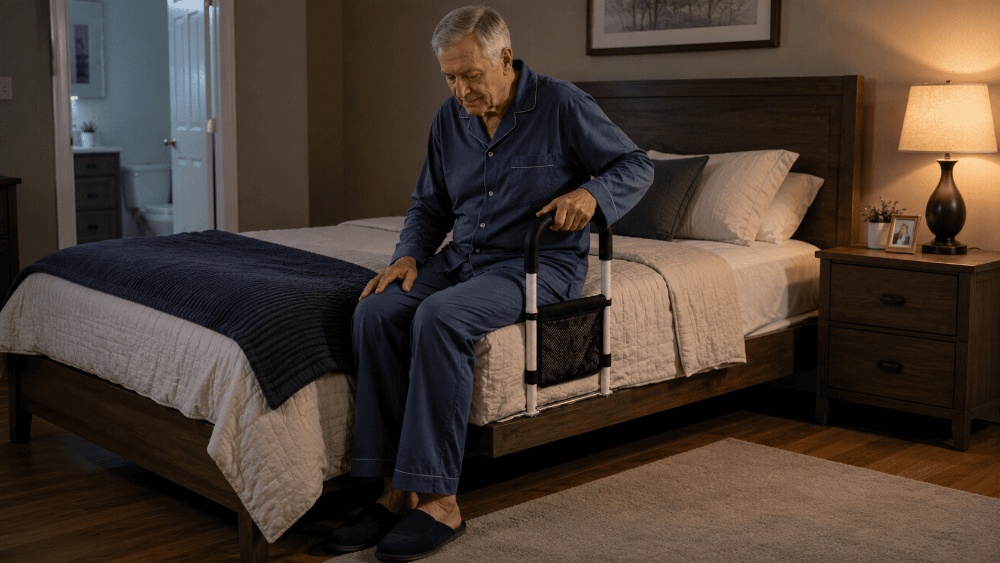
The first movement after waking is commonly less steady than movement during the day. Older users may sit up too fast. They might twist toward the room. Or they could try to stand before their feet are completely set. In this moment, a bed assist rail can provide a secure handhold at the bed edge. It helps the user slow the movement. The user applies force through the hand rather than pulling on unsteady furniture.
For care facilities and home care programs, the product should be evaluated as part of a transfer routine rather than as a single accessory. The user begins by sitting and pausing. After that, the user grips. The user places both feet firmly. Then the user stands. This sequence is more realistic than expecting one product to remove all risk. In addition, it gives staff a repeatable instruction point.
Support should not block normal bed access
A full-length guardrail may feel protective, but it can also complicate entry, exit, and caregiver access when the user mainly needs transfer support. For nighttime bathroom safety, the goal is usually controlled movement, not full bedside enclosure. A shorter assistive rail can leave enough open space for turning, standing, and caregiver assistance.
This distinction matters in retail positioning. A bedside rail for elderly users should be positioned as a transfer aid for users who can still participate in sitting and standing, but need a stable point during repeated night movements.
What Makes a Bedside Support Rail Suitable for Night Use
Once the use scenario is clear, buyers can evaluate product details with more accuracy. Night use puts pressure on small design choices that may look secondary in a catalog: grip texture, bed height compatibility, floor contact, mattress fit, and the ability to remove or reposition the rail when needed.
Grip, height, and bedside positioning
A rail used at night must be easy to locate by touch. A foam grip can make the handhold more comfortable and less slippery, especially for users with weaker hand strength or colder rooms. The grip should be positioned where the user naturally reaches while sitting on the mattress edge, not too far forward or too low.
Height also requires careful checking. If the rail is too low, the user may bend forward and lose balance. If it is too high, the shoulder may lift awkwardly and reduce leverage. For a bedside rail for elderly users, matching the rail to bed height and mattress thickness is a practical procurement issue. It affects return rates and actual user confidence.
Stability without complex installation
In private homes and rental settings, drilling into the floor, wall, or bed frame is often not acceptable. A no-drill structure can reduce installation barriers for families, care stores, and community nursing programs, provided the rail is still checked for stable placement. Stability should come from frame design, load distribution, contact points, and correct use, not from marketing language alone.
Public guidance on adult portable bed rails highlights concerns such as falls, improper fit, and entrapment risks, especially among older adults and users with physical or cognitive limitations. A responsible sourcing approach should treat elderly fall prevention as a system issue involving product fit, room layout, lighting, user condition, and caregiver instruction.
How XY-316 Fits a Home Care and Retail Supply Scenario
For suppliers building an elderly care product line, a bedside support rail should be easy to explain, easy to demonstrate, and practical for different bedroom settings. It should also have enough product information to support catalog pages, retail listings, distributor quotation sheets, and after-sales communication. This is where a specific model becomes easier to evaluate than a broad product category.
Product details that matter to procurement
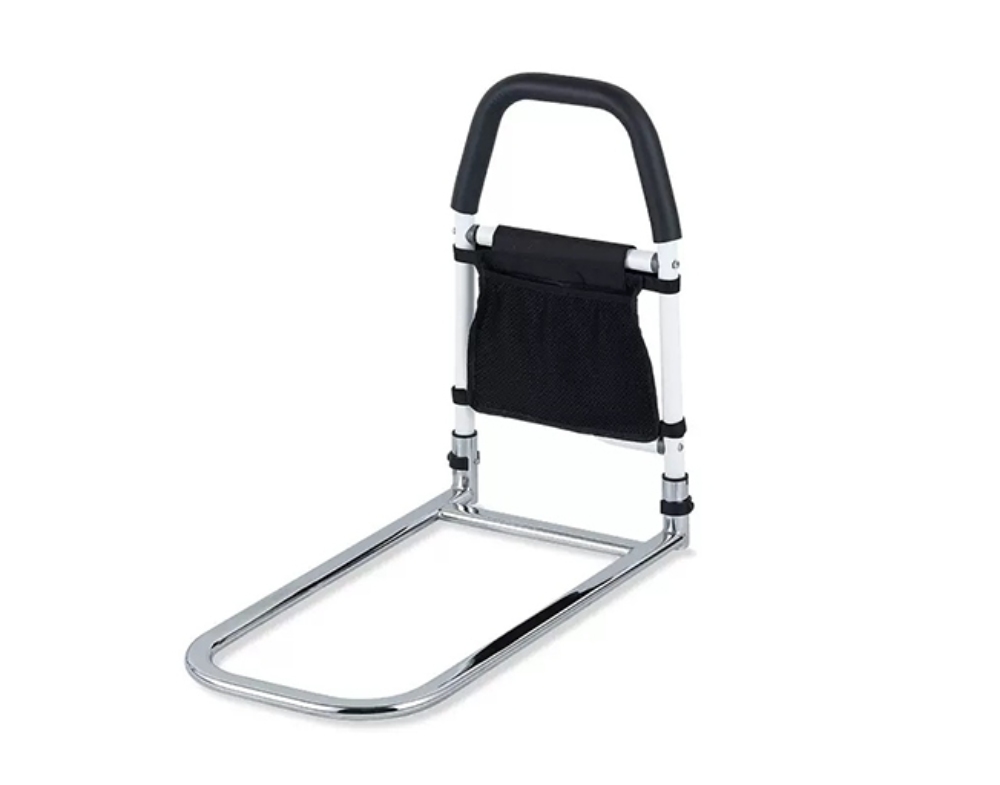
Xunyu 医療 provides assistive devices for elderly care, including bedside handrails, crutches, wheelchairs, bath chairs, and walking aids. Buyers comparing bedroom support products can also review the broader bedside handrails product range to evaluate different frame structures, installation styles, and support options before selecting a specific model. Within this category, the 炭素鋼ベッドサイドアシストレール XY-316 is designed with a carbon steel main frame, 1.2mm thick tube, electroplated lower frame, spray-coated upper frame, foam gripper, storage bag, flat tube design, removable structure, no-drilling installation, and height adjustment.
Its listed parameters are clear enough for B2B use: handrail length 35cm, base length 52cm, total height 50cm, net weight 1.75kg per piece, gross weight 2.3kg per piece, and load-bearing capacity 100kg. The single-unit packaging size is 56×10×36cm, while the five-piece carton size is 60×37×57cm for 5PCS. These details help buyers estimate shelf space, shipping volume, carton planning, retail display needs, and product-page specifications.
For nighttime bathroom safety, several details are especially relevant. The foam gripper supports easier hand placement. The storage bag can keep small bedside items, such as glasses or a phone, within reach. The no-drill design is useful where fast installation and later removal are required. The flat tube design also supports closer bedside positioning when bedroom space is limited.
Where it fits in a wider assistive product line
A single support product rarely solves every mobility need. Many users who need help getting out of bed safely may also need a walking aid, bath chair, raised toilet support, or wheelchair for longer movement. For distributors and elderly care retailers, its value is higher when it sits within a broader mobility and bathroom safety assortment.
XY-316 can be positioned as a bedroom transfer aid, while other products address walking, bathing, and seated mobility. This makes the product easier to sell in packages for home safety upgrades, post-surgery recovery, senior living supply, or family care stores.
Buyer Checklist for Safer Nighttime Bedroom Setups
A strong rail is only one part of elderly fall prevention. Before adding a product to a care plan or retail recommendation, buyers should consider how the user moves from bed to bathroom and what obstacles appear along that route.
First, assess the user’s ability. A bedside support rail is more suitable for users who can follow instructions, grip, sit at the bedside, and place their feet on the floor. Users with severe confusion, uncontrolled movement, or high entrapment risk need professional assessment before any rail is used.
Second, check the bed environment. The mattress should be firm enough for stable sitting, and the rail should sit close enough to support the hand without creating unsafe gaps. Public safety information on adult portable bed rail safety emphasizes caution because poor fit can create serious risks.
Third, improve the route to the bathroom. Night lights, clear walking space, non-slip footwear, and a reachable phone are part of the same safety plan. A user may get out of bed with good support but still face hazards in the first few steps.
Fourth, review installation and inspection routines. In B2B supply, the product manual, carton labeling, after-sales instructions, and customer education should explain setup limits clearly. Retailers and care providers should remind users to check stability, floor contact, and loose parts regularly.
Finally, avoid overpromising. A support rail can assist getting out of bed safely, but it should not be presented as a guarantee against falls. Better content, sales training, and product descriptions help protect both the user and the supplier.
結論
Nighttime bathroom trips are a small daily routine, but they expose several mobility risks at once. For B2B buyers, the right product choice should begin with the movement itself: sitting up, turning, standing, and walking in low light. A practical bedside support product should provide grip, stability, suitable height, simple installation, and clear usage guidance. XY-316 fits this scenario as a no-drill carbon steel assistive rail with foam grip, storage bag, flat tube design, and 100kg load-bearing capacity. For procurement teams comparing home care support products, careful matching between user ability, bed setup, and product structure is still essential. To discuss product details or request supply information, buyers can send a product inquiry.