

What Are the Advantages of Electric Wheelchairs Compared with Manual Wheelchairs?
Time : Jan 28, 2026 View : 717
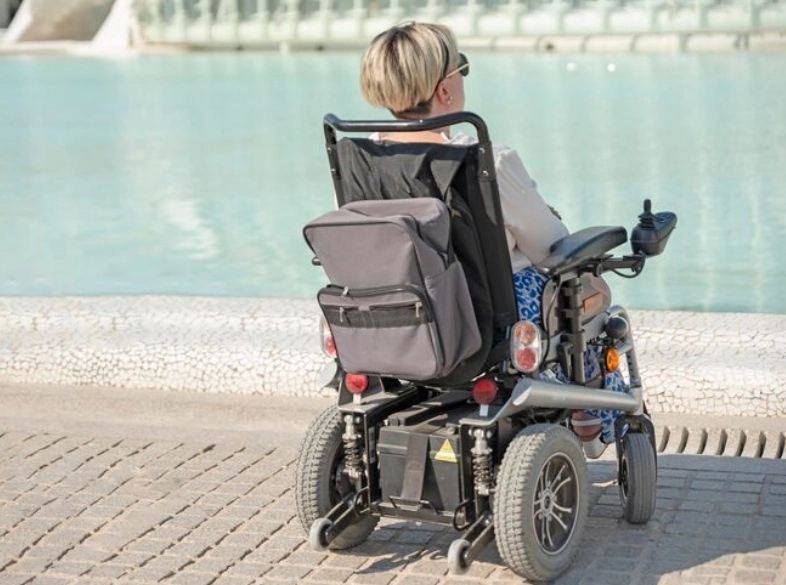
Why this comparison is no longer about comfort, but about system performance
For decades, the comparison between electric and manual wheelchairs centered on convenience, but the framing is now outdated. In modern mobility planning, the choice of wheelchairs is no longer two simple transport devices but two distinct mobility systems with different mechanical principles, user-machine interaction patterns, and long-term performance characteristics.
Manual wheelchairs depend almost completely on physical effort from the users. Electric wheelchairs, however, replace human effort with controlled electromechanical systems. This change affects fatigue accumulation, travel stability, safety margins, daily coverage radius, and even the allocation of care resources.
As older populations increase and home-centered long-term care grows dominant, mobility devices function more as an essential infrastructure. Reliability, energy consumption, structural durability, and lifecycle expense are now more important than short-term comfort. Against this background, the benefits of electric wheelchairs are measurable instead of personal opinion.
Who is Xunyu Medical and why does its product logic matter in real mobility scenarios?
When evaluating electric wheelchairs as engineered systems, the manufacturer’s design philosophy becomes critical. One representative example is Xunyu Medical, an assistive-device producer based in Danzao Town, Foshan, China, operating a 4,000-square-meter manufacturing facility dedicated to mobility and daily-care equipment for elderly users.
Our portfolio is not just limited to wheelchairs, and includes walkers, bath chairs, bedside commodes, toilet armrests, bedside rails, and toilet risers. These products are designed to work together as a coordinated home-care system. From the establishment of our company, product development has been driven by technical iteration, which is manifested in refining frame geometry, improving functional layouts, and reducing operational complexity so devices remain usable even under declining motor control or strength.
Equipment from our company is exported to Europe, North America, the Middle East, and the Asia-Pacific areas through major online platforms and healthcare suppliers. This reflects a production system aligned with global standards and a stable, long-term supply. Internally, our company’s stated goal focuses on supporting independent living through trustworthy and well-planned products. Meanwhile, continuous investment in R&D and eco-friendly production seeks to maintain consistent operation across longer product lifecycles.
This engineering-first approach shows that electric wheelchairs are no longer treated as accessories but as structural mobility assets.
Can you really rely on upper-body strength for daily mobility over the years?
Why manual propulsion creates cumulative fatigue, joint overload, and unstable travel efficiency in real environments
Manual propulsion distributes load primarily across the shoulders, elbows, wrists, and the thoracic spine. Even moderate daily distances create repetitive micro-trauma, which accumulates into chronic joint degeneration and muscular imbalance. Once fatigue sets in, propulsion efficiency drops sharply, along with inconsistent travel speed and increased stopping distance.
Environmental resistance compounds the problem. Carpet fibers, expansion joints, curb ramps, and slight gradients all multiply required torque. You compensate with a higher stroke frequency, which further raises metabolic cost and joint stress. Over months and years, this cycle narrows your safe travel radius.
Electric wheelchairs break this dependency by decoupling motion from muscle output. The users’ strength is reserved for posture control, navigation decisions, and transfers, not propulsion. The result is predictable travel efficiency across surfaces and time.
Does electric drive change how safely you navigate slopes, ramps, and indoor obstacles?
How motor torque control, electronic braking, and frame geometry reshape stability margins during daily travel
Slope negotiation exposes the structural difference between the two systems. In a manual chair, ascent depends on transient bursts of force, and descent relies on rim friction and hand modulation. Both are vulnerable to error under fatigue or reduced grip.
Electric wheelchairs rely on continuous torque delivery and closed-loop braking. Motor controllers regulate acceleration, maintain speed under load, and apply regenerative or electromagnetic braking automatically. Stability is further enhanced by weight distribution, anti-tip geometry, and low-center battery placement.
Indoors, it indicates smoother transitions over thresholds and predictable stopping near furniture or doors. Outdoors, it reduces rollback risk on ramps and prevents uncontrolled descent. Safety becomes an engineered property rather than a human variable.
How much autonomy do you actually gain when propulsion becomes electric?
Why electric wheelchairs turn mobility from assisted movement into schedule-controlled independence
With manual propulsion, autonomy is constrained by endurance. Tasks must be grouped, rest intervals scheduled, and assistance anticipated. Electric propulsion converts mobility into an on-demand function.
Users can maintain consistent speed over long corridors, navigate retail environments without repeated stops, and plan multi-hour outings without calculating remaining physical capacity. Control interfaces allow fine directional input with minimal force, supporting users with limited dexterity.
The system also supports psychological independence. Predictable movement encourages spontaneous decision-making rather than risk-avoidant planning.
Can lightweight carbon structures offset the traditional disadvantages of electric wheelchairs?
How carbon-fiber frames and shock-absorption systems redefine portability and structural load distribution
Electric wheelchairs historically traded mobility for weight, but modern material engineering is changing the balance.
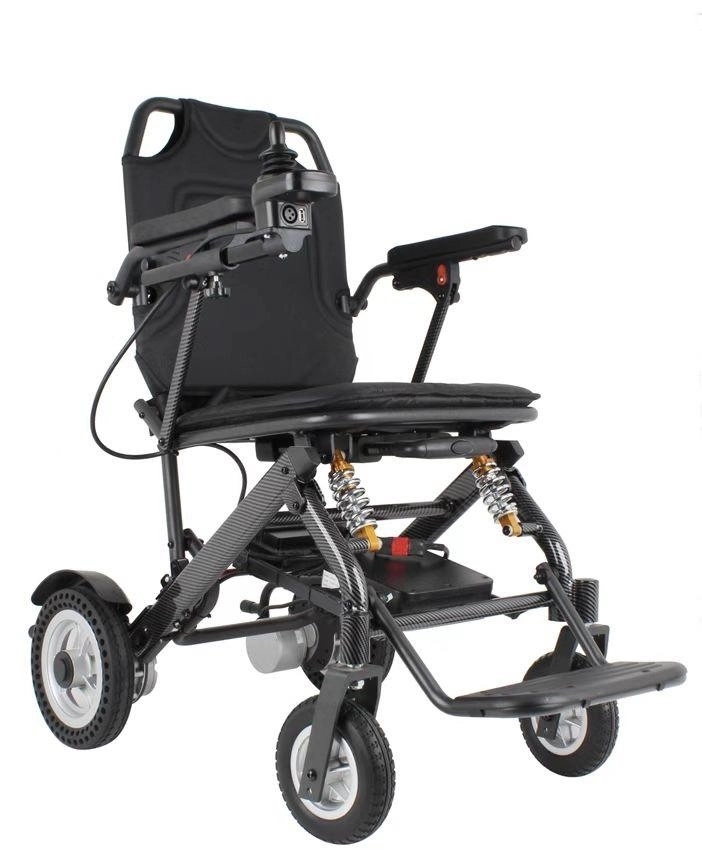
A representative design approach can be seen in the XY-D01L electric wheelchair. Its carbon-fiber transfer-molded frame reduces mass while maintaining torsional rigidity. Integrated shock-absorption elements dampen vibration transmitted from uneven surfaces, protecting both structural joints and user posture. Lower frame weight decreases battery load, extending operational range per charge cycle. Such architectures narrow the traditional gap between powered and manual systems in terms of handling and transport practicality.
Is battery range more important than charging speed in real deployment?
How usage patterns, indoor density, and power management determine effective daily coverage
Nominal battery range figures matter less than functional coverage. Users spend most time indoors or on short community routes, where stop-start cycles dominate energy consumption.
Efficient motor controllers, regenerative braking, and stable cruising speeds preserve charge better than raw capacity. Fast charging matters mainly in institutional settings with high device turnover.
Consistent power delivery throughout the discharge curve is more valuable than peak capacity, since voltage drops translate directly into speed instability in poorly regulated systems.
Do electric wheelchairs reduce the long-term total cost of mobility systems?
Why maintenance cycles, caregiver dependency, and injury risk redefine total ownership cost
Manual chairs appear cheaper upfront, but indirect costs accumulate due to physical therapy, joint treatment, caregiver labor, and productivity loss.
Electric wheelchairs introduce battery replacement and electronic servicing, but they significantly reduce musculoskeletal injury rates and assistance hours. Modular drive systems allow targeted maintenance rather than full unit replacement.
When calculated over multi-year deployment, the electric system often proves financially and operationally more stable.
How does ultra-light carbon design influence transport, storage, and airline compatibility?
Why structural density matters more than nominal weight numbers in logistics scenarios
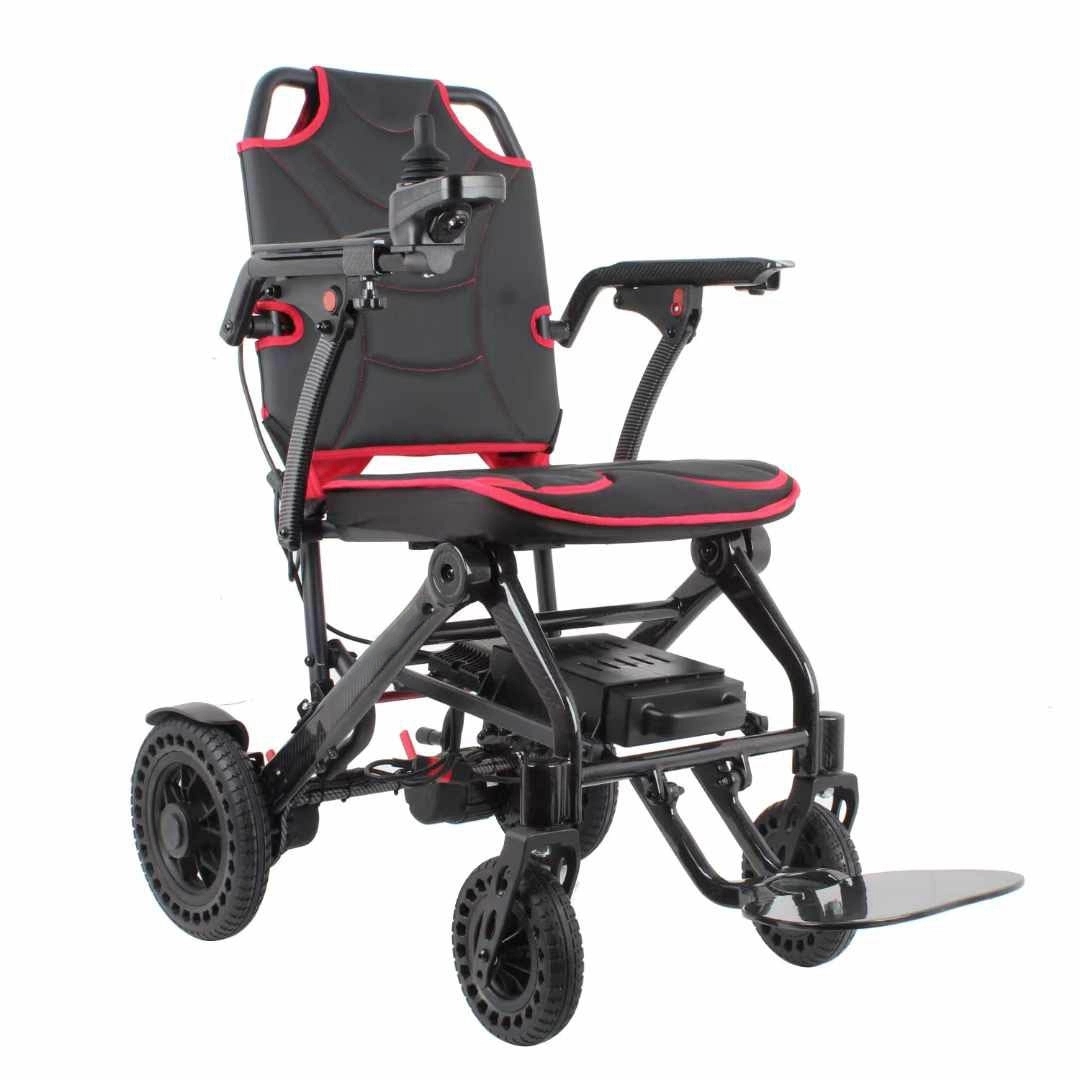
Another illustration is the XY-D02L electric wheelchair. Its pure carbon-fiber chassis emphasizes density optimization—maintaining strength while minimizing cross-section thickness, which reduces folded volume and simplifies vehicle loading. For air transport, lower structural mass eases compliance with battery transport regulations and cargo limits.
In-home environments, compact folding geometry allows storage in narrow corridors or shared living spaces without disassembly.
When does a manual wheelchair still make sense?
Practical scenarios where mechanical simplicity still outperforms motorized systems
Manual wheelchairs remain practical for short transfers, temporary recovery phases, or environments without charging infrastructure. They also suit situations requiring ultra-low acquisition cost or minimal maintenance capability.
Why electric wheelchairs represent a structural upgrade, not a feature upgrade
Electric wheelchairs change the mobility from biological effort to engineered reliability. The stabilize the speed, extend daily reach, reduce physical deterioration, and turn movement into a controlled activity.
As materials, motor control, and battery technology advance, the difference between powered and manual mobility becomes less about luxury and more about life quality. Sustained independence, steady behavior, and safety become core elements of modern mobility design.
FAQs
Q1: Do electric wheelchairs require significantly more maintenance than manual wheelchairs?
A: Not necessarily. Modern electric wheelchairs use modular motors and standardized battery packs. While electronics add complexity, they also reduce mechanical wear on bearings and rims, resulting in predictable service cycles.
Q2: Is carbon fiber durable enough for long-term daily use?
A: Yes. Carbon-fiber structures designed for mobility devices are engineered for cyclic fatigue and vibration resistance. In many cases, they outperform aluminum frames in long-term structural stability.
Q3: Will electric wheelchairs limit indoor maneuverability compared with manual models?
A: No. Compact wheelbase layouts and high-precision motor control allow modern electric wheelchairs to achieve turning radii comparable to, or smaller than, many manual designs.


