

Four-Wheel Walker with Seat: What Should Medical Equipment Buyers Compare?
Time : Nov 05, 2026 المشاهدات : 38
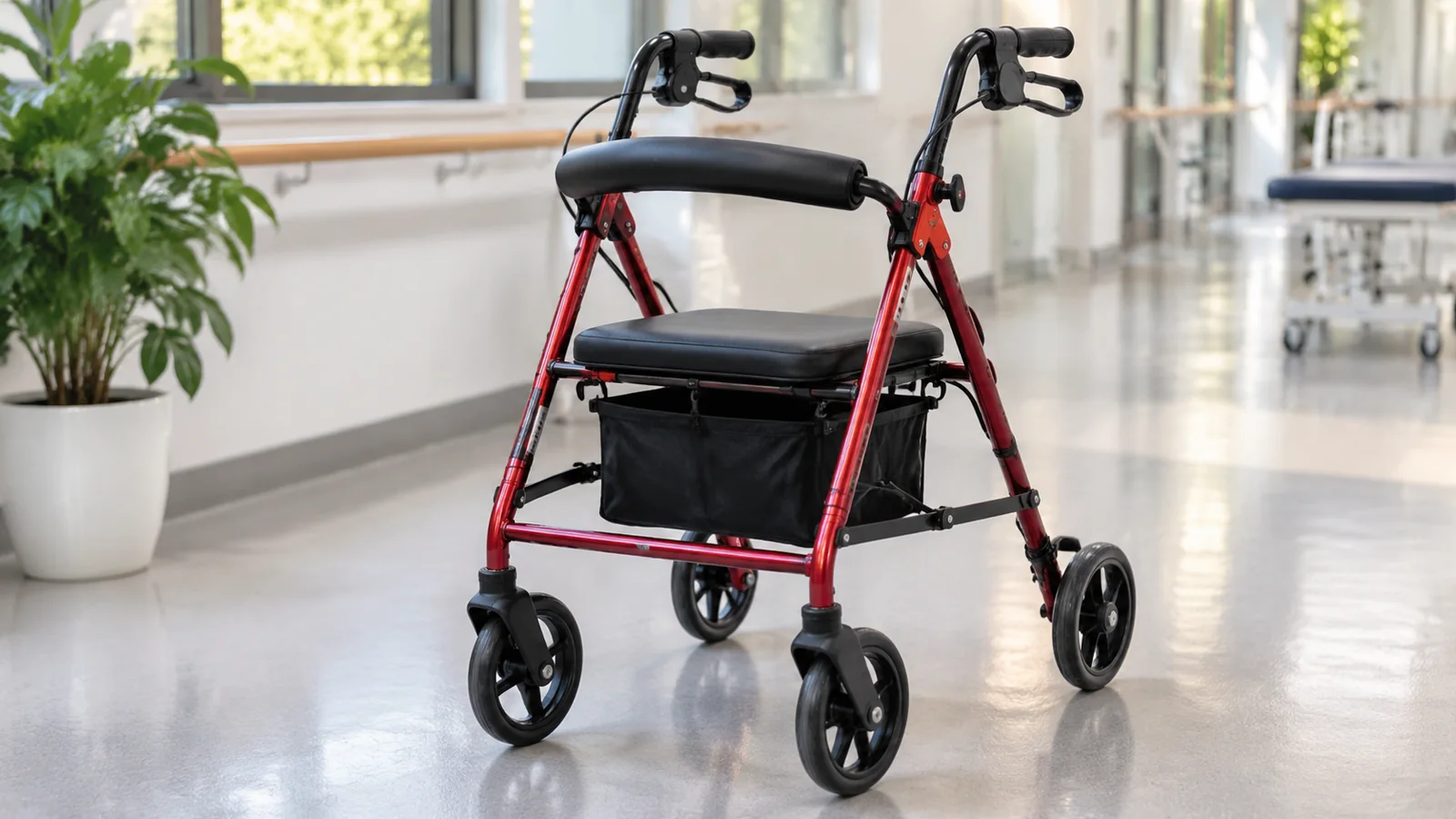
A four-wheel walker with seat combines rolling support with a place to sit when a rest is needed. For distributors, the category can appear straightforward, but models differ in frame dimensions, seat size, handle adjustment, wheel configuration and braking system. Those details affect how a.
How Does a Four-Wheel Walker with Seat Differ from Other Walkers?
A four-wheel rollator is pushed forward while the user walks, rather than being lifted and placed down at each step like many standard walking frames. A built-in seat provides a place to rest when the unit is stationary and secured according to its instructions. This distinction matters when a buyer is building a product range: a rollator with a seat is not the same as a knee walker, a fixed-frame walker or a basic two-wheel walking aid.

Four-wheel rollator versus standard walker
A standard walker generally has a simpler frame and may require lifting or repositioning. A four-wheel rollator uses wheels to move continuously and normally includes a braking system. Buyers should not describe all four-wheel models as suitable for every surface or user. Wheel size, tyre material, frame geometry, braking design and the user’s ability to control the handles all affect the product’s practical use. The user manual and professional assessment should guide the intended application.
Walking support and seated rest are separate functions
The seat is intended for rest when the walker is stationary and secured in accordance with the instructions. It is not a moving seat or a transport chair. Buyers should confirm whether the model includes a backrest, whether that part is removable and how the seat is supported. The catalogue should explain the function without suggesting that the user can sit while the walker is rolling. This distinction is important for clear product information and safe customer communication.
Which Product Specifications Matter Most?
A product comparison should cover dimensions, adjustment ranges, weight, rated load, folding size, wheel details and braking. These fields are connected but should not be merged. For example, seat width does not describe the total width of the walker, and the net weight does not describe the carton weight. A distributor’s product database should keep each figure in its own field and use the same measurement method across models.
Frame material and folding structure
Frame material affects product weight, surface treatment and the way the frame is described. The XY-9001 uses an aluminum-alloy frame with a carbon-transfer printing finish. The XY-803 uses an aluminum frame with a painted finish. Both are described as foldable, but the folded dimensions differ. A buyer should check the locking points and folding sequence on the sample, then compare them with the manual rather than assuming that similar-looking frames fold in the same way.
Seat dimensions and handle adjustment
Seat width, seat depth and seat height should be checked separately. Handle height also needs a defined adjustment range, because the user’s posture and ability to reach the controls depend on the final setting. The XY-9001 has a 43 cm seat width, 24.5 cm seat depth, 51 cm seat height and handle height range of 82–95 cm. The XY-803 has a 45.5 cm seat width, 24.5 cm seat depth, 54 cm seat height and handle height range of 78–90 cm.
Wheel configuration and brake design
Wheel diameter and material should be listed for the exact model. The XY-803 has 8-inch PVC front and rear wheels and a self-locking brake system. The XY-9001 offers six handle-height positions; its wheel and brake configuration should be confirmed for the selected variant. Do not transfer the XY-803 brake specification to XY-9001. If a buyer needs a particular brake or wheel configuration, request confirmation before finalising the quotation.
How Should Buyers Compare Different Walker Configurations?
The XY-9001 and XY-803 both include a seat and folding structure, but their dimensions and details differ. The comparison helps buyers distinguish the two configurations; it does not mean either model suits every user or every sales channel.
XY-9001 configuration
The standard XY-9001 weighs 7.95 kg net and 8.9 kg gross. Its seat measures 43 × 24.5 cm, the seat height is 51 cm, the unfolded dimensions are 62 × 64 × 82–95 cm and the folded dimensions are 46 × 22 × 87 cm. The stated load capacity is 100 kg. It has an aluminum-alloy frame, adjustable handles with six marked positions, an Oxford-cloth seat and a folding structure. A separate XY-9001 version is listed with a footrest, so the variant must be identified on the order.
XY-803 configuration
The XY-803 weighs 7.9 kg net and 9 kg gross. Its seat measures 45.5 × 24.5 cm, the seat height is 54 cm, the unfolded dimensions are 66 × 64 × 78–90 cm and the folded dimensions are 67 × 27 × 78 cm. The stated load capacity is 100 kg. Its configuration includes an aluminum frame, painted finish, self-locking brakes, six handle-height positions and 8-inch PVC wheels. The seat and frame dimensions should be used to compare fit and storage requirements rather than relying on the model name alone.
What Should Distributors Check Before Bulk Ordering?
Before ordering, compare the quotation with the approved sample and technical sheet. Confirm the model code, seat dimensions, handle adjustment range, wheel specification, brake system, accessories, carton dimensions and user manual. If a version includes a footrest or a different handle arrangement, the option must appear clearly in the purchase documents. A sample approval sheet should also record the date and revision of the specification used.
Sample inspection and adjustment
Open and fold the walker using the stated method. Check that adjustment pins engage fully, handles remain at the selected height and the seat is attached as described. Operate the brakes and inspect the wheels for visible damage or looseness. These are repeatable product checks; they do not replace formal testing or an individual user assessment. Any acceptance criteria for a bulk order should be agreed before production rather than invented during receiving inspection.
Packaging and after-sales information
Carton size and gross weight affect storage and freight planning. The XY-9001 is listed with a 50 × 21.5 × 89 cm single-piece carton, while the XY-803 is listed with a 65 × 28 × 35 cm carton. Confirm these values against the current packing plan. Ask whether replacement wheels, brake components, adjustment pins and seat parts can be identified and ordered by model. Keep the user manual and spare-part references with the product record.
Distributors comparing rollators and other mobility products can review Xunyu Medical’s مجموعة أدوات المساعدة على المشي and check the configuration for each model.
The two rollator models should be compared by their own seat, handle and brake specifications.
For distributors evaluating the manufacturer, Xunyu الطبية supplies elderly-care and mobility-assistance products to overseas channels.
For the XY-803, the self-locking brake system and 8-inch PVC wheels are part of the listed configuration. The XY-9001 should be quoted against its own selected variant, particularly when a footrest is required. These details should not be transferred between model records.
If a distributor requires a particular accessory or label format, the request should appear on the quotation and approved sample record. A general note about a product family is not a substitute for confirming the exact variant.
Distributors considering product or packaging changes can review Xunyu Medical’s ODM/OEM services and confirm the options available for the selected walker model.
Confirm the selected variant and any accessories before requesting the final quotation.
For a model-specific quotation, share the target market, preferred variant, order quantity and packaging requirements with اتصل بمركز شونيو الطبي.
أسئلة متكررة
Q: What is the difference between a rollator and a standard walker?
A: A rollator uses wheels for continuous movement and commonly includes hand-operated brakes. A standard walker may need to be lifted or repositioned. The exact design varies by model.
Q: Can a four-wheel walker with a seat be folded for storage?
A: Some models are foldable. Buyers should check the specified folding dimensions and the steps in the user manual for the exact model.
Q: Which specifications should distributors compare?
A: Compare seat width and depth, seat height, handle adjustment, overall and folded dimensions, net and gross weight, rated load, wheel details, brake design and carton size.


