

How Buyers Should Source Crutches for Disabled People
Time : Sep 08, 2026 المشاهدات : 63
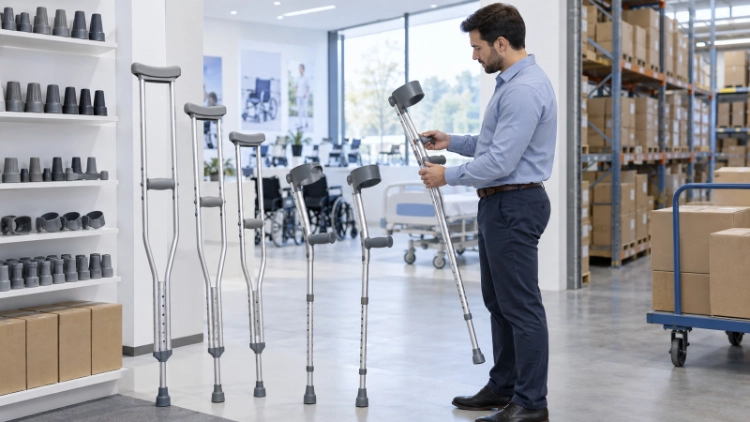
Crutches for disabled people cover more than one product type, price point, or care setting. A pharmacy may need standard underarm crutches for short-term recovery. A rehabilitation centre may prefer forearm models with clear fitting instructions, while a home-care distributor may need a mixed range that is easy to store and support. Buyers in Malaysia, Singapore, and other Southeast Asian markets also have to consider humid storage conditions, compact retail space, local-language materials, and the cost of replacement parts. A sound procurement brief connects the intended users and sales channel to a model, size range, service plan, and verified order specification.
Start with users and sales channels
Procurement teams should define who will issue or sell the product before comparing quotations. Hospitals and rehabilitation centres may have trained staff who can fit the aid. Pharmacies and online channels may need clearer size selection, illustrated instructions, and simple replacement-part identification. Home-care projects may place more weight on handling, storage, and caregiver support. These differences affect the size mix and product documentation required in the order.
The phrase crutches for disabled people should not become a universal suitability claim. Some users need support for a short recovery period, while others use a mobility aid for longer periods. Balance, strength, weight-bearing instructions, and fit must be assessed by a qualified professional. Buyers can specify product features and intended channels without presenting one model as suitable for every user.
Compare crutch types and fit ranges
Underarm and forearm crutches serve different needs
Underarm crutches are common in recovery and general medical supply channels. Forearm crutches use a cuff and handgrip and may suit different rehabilitation or long-term mobility programmes. Buyers should compare frame design, adjustment method, cuff or pad construction, handgrip position, rubber tips, and the fitting process. A mixed medical crutches range may be useful when the distributor serves clinics, retail outlets, and home-care customers.
Check size and adjustment points
إن XY-925 aluminum crutches come in Small, Medium, and Large sizes. The foot tube has nine adjustment levels, and the grip has five. These are separate fitting points and should appear separately in the RFQ. Sample checks should confirm that the buttons engage fully, paired crutches can be set to equal height, and the selected setting remains stable. Product teams should confirm the intended user range for each size rather than relying only on the words adjustable crutches.
Treat material as one buying factor
Aluminum crutches can support a lighter product position than many steel alternatives, but the material name alone does not establish load capacity or durability. XY-925 offers 1.0 mm, 1.1 mm, and 1.2 mm tube thickness options. The selected option should remain tied to the quotation, sample, labels, and order confirmation. Buyers should obtain the load rating and any related test or compliance documents for the exact configuration.
Build a product range for Southeast Asia
Many distributors need more than one price tier. An entry-level range may cover standard underarm crutches with clear size choices. A mid-range offer may add stronger packaging, more adjustment options, and separately identified wear parts. Premium channels may focus on lower weight, compact storage, refined finishes, or specialised forearm designs. The product portfolio should reflect actual customer groups rather than adding several similar models with no clear difference.
The wider Xunyu Medical crutch category can help buyers compare available designs before narrowing the range. A shortlist should record the target channel, size coverage, material, adjustment system, packing volume, intended retail position, and spare-part route for each model.
Climate and storage conditions also affect the buying brief. In humid markets, distributors should ask how metal surfaces, fasteners, pads, grips, and cartons should be stored and cleaned. Singapore buyers may care about compact storage in clinics and small retail areas. Malaysian distributors may place more emphasis on regional delivery, home-care demand, and stock movement between dealers. These are procurement scenarios, not claims that one product automatically suits every local environment.
The final shortlist should work as a complete crutches bulk order rather than a collection of unrelated samples. Buyers need to check whether size ratios, carton quantities, spare parts, manuals, and price tiers can be combined in one shipment. Related mobility aid products may also share the same distributor channel, but their packaging and service requirements should remain separate. Recording those differences early reduces last-minute changes to quantities, artwork, and warehouse plans.
Evaluate the supplier behind the product
Confirm commercial and OEM terms
A crutches supplier should answer the same set of questions for each shortlisted model. Confirm MOQ, sample cost, production lead time, available size mix, carton quantity, packaging dimensions, payment terms, and replacement-part ordering. If the buyer sells under a local brand, ask about logo placement, carton artwork, labels, manuals, product photographs, and language versions. OEM support should be treated as a defined set of deliverables rather than a general sales promise.
Buyers can send their channel, target price tier, branding needs, and forecast quantity through the Xunyu Medical service enquiry. The final quotation should state which items are included and which require additional cost or lead time.
Plan packaging and after sales support
Packaging affects freight, warehouse space, e-commerce delivery, and damage rates. Record net and gross weight, carton dimensions, units per carton, protective materials, and model and size markings. Ask whether assembly is required after delivery and which tools or instructions are included. For mixed orders, the carton mark should let warehouse staff separate sizes without opening every box.
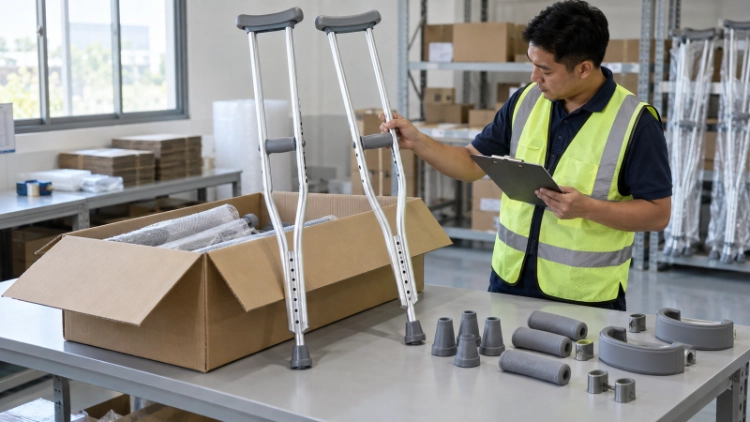
Spare parts availability deserves the same attention as the main unit. Rubber tips, crutch pads, cuffs, and handgrips can create low-cost but frequent service requests. Confirm part numbers, model compatibility, minimum spare quantity, packing method, price, and expected supply route. A distributor should not promise permanent availability until the manufacturer confirms the terms.
Approve samples and supporting records
The approved sample should match the quoted model, size, material option, adjustment structure, contact parts, labels, manual, and packaging. Test more than one adjustment position and compare paired units for equal height. If the order includes several sizes, include each size in the sample or pre-shipment inspection plan. Keep the signed specification and sample record with the purchase order so receiving teams have a practical reference.
User instructions should stay within verified product use and fitting boundaries. MedlinePlus guidance on using crutches stresses height adjustment, weight through the hands rather than the armpits, and healthcare-provider instructions. A buyer-facing manual can reinforce those points without making treatment claims or certifying a model for every user.
استنتاج
A dependable range of crutches for disabled people begins with clear user groups and sales channels. Buyers then need to compare crutch type, size coverage, adjustment points, materials, price tiers, packaging, OEM support, and replacement parts. Sample approval and written order records connect those decisions to the delivered batch. This approach gives medical equipment buyers a fuller basis for supplier comparison across product, service, and commercial requirements. It also supports clearer receiving, stock planning, staff training, and after-sales decisions across the distribution chain.
Distributors can review the broader mobility aid products available from Xunyu الطبية and request model-specific commercial and technical details before placing a crutches bulk order.
الأسئلة الشائعة
Q1: What should buyers compare first when sourcing medical crutches?
A1: Start with intended users, sales channel, crutch type, size range, fitting responsibility, and target price tier before comparing quotations.
Q2: What should a crutches supplier include with a bulk order?
A2: Confirm labels, manuals, carton marks, packing data, replacement-part identifiers, inspection records, and any agreed OEM materials.
Q3: What matters to crutch buyers in Southeast Asia?
A3: Buyers may need mixed price tiers, compact storage, humid-condition care guidance, local branding support, and a clear spare-parts route for Malaysia, Singapore, and nearby markets.


