

ما الذي يجب أن يتضمنه دليل مستخدم أدوات المساعدة على الحركة؟
Time : Oct 07, 2026 المشاهدات : 56

The sample frame opens correctly, the carton artwork has been approved, and the order is nearly ready. Then someone checks the instruction booklet and finds a different locking mechanism in the illustration. The text may be fluent and the layout tidy, but the buyer still needs to stop the approval process and resolve the mismatch.
A mobility aid user manual has to work beside the product in the carton. For a private label order, reviewing it against the actual sample is more useful than reading the PDF alone. The details that deserve attention are often small: a hidden button, an extra collar or an accessory shown in the wrong position.
Review the manual with the approved sample
Begin by checking the model and configuration. Similar products can share a frame outline while using different adjustment or folding components. A manual covering several variants needs to make those differences clear enough that the user can follow the correct instructions without guessing which version they own.
Place the approved sample beside a printed proof and work through the documented sequence. This is a document review, carried out by someone familiar with the product and its safe operation. Record any point where the reviewer has to supply knowledge that the booklet does not provide. That missing information may be obvious to an experienced buyer and entirely unfamiliar to a carer opening the carton.
The parts supplied with the order matter too. If assembly requires a fixing, tool or accessory, the contents illustration should agree with the actual pack. A missing part and an unclear drawing can produce the same initial complaint, so a clear contents section helps the distributor establish what has happened.
Explain how to recognise correct engagement
An instruction to open or adjust a product is incomplete when the user cannot tell whether the mechanism has engaged. The manual should explain the confirmation relevant to that design, with an illustration that shows the important position. It should also state what to do if engagement cannot be achieved.
Consider a height adjustable bathing product with spring buttons. Its instructions may require equal leg settings and buttons that emerge fully through the adjustment holes. A distant photograph of the complete chair will not necessarily show either condition. A close view can be more useful than another full product image.
Similar actions can require different instructions
The XY937 forearm crutch uses spring buttons and adjustment collars that must be secured after setting the height. A generic sentence about height adjustment would miss part of that sequence. When a supplier changes a component, the buyer needs to check whether the corresponding text and image still explain the complete operation.
Wheelchairs raise a different set of questions. For the XY1001A, folding instructions involve a safety buckle and the positions of the footplates and armrests. Those details belong to that model’s sequence. They should not be replaced with a generic wheelchair folding diagram simply because it occupies less space on the page.
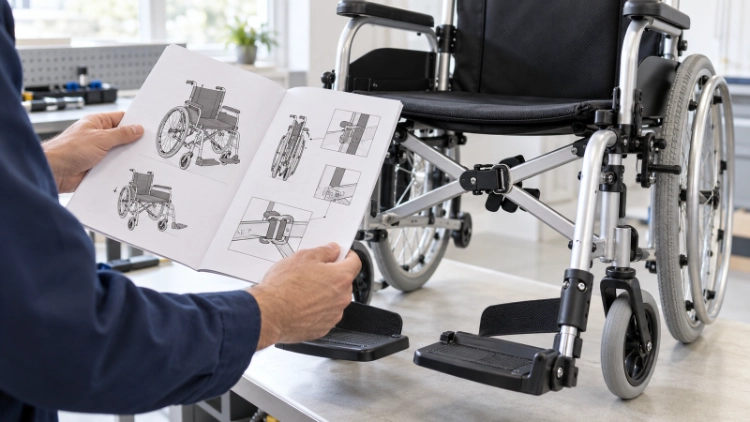
These examples also explain why a shared manual template needs careful editing. A familiar layout is useful, but copying the operating text between models can leave a convincing instruction for the wrong mechanism.
Put limits where the user needs them
The manual should identify the intended use, relevant restrictions and the product’s specified limits. Values such as maximum user weight must match the exact model and configuration. A figure taken from a similar product can remain unnoticed through several rounds of design approval if nobody checks it against the technical record.
Warnings need context. A restriction related to folding should be visible in the folding section as well as wherever the full safety information is collected. Users should not have to connect a warning at the front of the booklet with an unexplained step several pages later.
Maintenance and cleaning also need product specific content. Identify the checks users are expected to perform, what should prompt them to stop using the aid, and how they can obtain assistance. Cleaning instructions must account for the supplied surfaces and components. A broad statement to keep the product clean leaves distributors answering questions the booklet could have resolved.
The UK MHRA guidance on managing medical devices is a useful reference on accessible instructions, training and equipment records. Its role here is to inform the review process. It does not establish that a booklet meets the requirements of every destination market.
Translation needs a second product check
A translated booklet can preserve the general meaning while losing the name of a component or the order of an action. Give the translator the approved source text, labelled product images and a consistent parts vocabulary. Queries about ambiguous instructions should return to the person responsible for the product, rather than being settled through wording alone.
After translation, repeat the comparison with the sample. Check the operating sequence, warnings, numbers, units and model references. The person reviewing the target language needs to understand the product well enough to recognise when a natural phrase has changed an instruction.
Print size is another practical issue. Additional languages may turn a readable booklet into tightly packed pages. Review the printed proof at its intended size, including the smaller labels inside diagrams. Enlarging a PDF on screen can hide a problem that becomes obvious when the booklet is held beside the aid.
Control the version that enters the carton
An approved PDF is only useful if production receives that version. Assign an identifiable revision and keep the approval tied to the product configuration. A change to a lock, accessory or adjustment part should trigger a review of the affected instructions and illustrations before the next production batch is packed.
For a private label order with Xunyu الطبية, agree who provides the source text, arranges translation, checks market requirements and approves the final proof. Those responsibilities need to be settled before artwork is released. The manufacturer’s standard booklet may be a starting point, but the branding and language scope of an individual order still require agreement.
For an order spanning several mobility aid categories, keep the approvals separate by model. A shared brand design can sit across the range while each product retains the instructions and identification it needs. Retain the final files so a customer support team can locate the correct version later.
الأسئلة الشائعة
Can several models share one user manual?
They can where the instructions clearly identify the relevant variants and remain usable for each one. Significant differences in mechanisms, assembly or limits may justify separate booklets. Check the proposed format with the actual products before approving it.
Is a QR code enough to provide instructions?
Do not assume it replaces printed information. Consider the user, access to the linked material and the applicable requirements in the destination market. Any digital version should be identifiable, accessible and consistent with the product supplied.
When should the booklet be reviewed again?
Review it when the product, accessories, instructions or relevant requirements change, and when support enquiries reveal an unclear step. A hardware change that looks minor to the purchasing team may alter what the user must do.
Bring the model list, destination market and language requirements to the فريق الاتصال الطبي في شونيو when discussing a private label order. Agree the documentation scope and approval responsibilities alongside the product sample. That leaves a clear reference for the booklet that will travel with the finished goods.


