

Avion couloir fauteuil roulant guide 2026: Qu'est-ce qui rend un fauteuil roulant adapté pour les transferts aéroport et cabine?
Heure : 12 mai 2026 Vue : 1 595

Les voyages aériens peuvent être fatigants pour les passagers à mobilité restreinte. Même une courte distance de la zone d'enregistrement à la porte d'embarquement peut inclure de longs couloirs. Il peut également comporter des contrôles de sécurité, des ascenseurs fréquentés et de multiples points de transfert. Le moment le plus difficile arrive généralement plus tard: passer d’un fauteuil roulant standard à un siège d’avion à travers un couloir étroit de cabine. En 2026, l’assistance en fauteuil roulant à l’aéroport attire de plus en plus d’attention. C’est parce que les régulateurs, les compagnies aériennes, les familles et les prestataires de soins examinent tous les transferts sécurisés plus attentivement. Ils examinent également les aides à la mobilité endommagées et améliorent la gestion des passagers en fauteuil roulant.
Pour les acheteurs d'équipements médicaux, les fournisseurs de services aéroportuaires, les maisons de retraite, les cliniques et les équipes de soins de voyage, un fauteuil roulant Airplane Aisle n'est pas seulement une chaise plus petite. Il fonctionne plutôt comme un outil de transfert pratique. Cet outil est conçu pour les espaces étroits, les mouvements à courte distance, la sécurité de l'utilisateur et le contrôle des accompagnateurs.
Pourquoi les transferts aéroportuaires auront besoin d'un fauteuil roulant différent en 2026
Les routes aéroportuaires créent une pression de transfert répété
Les aéroports comportent plusieurs étapes de déplacement courtes mais exigeantes. Un passager peut passer d'un fauteuil roulant personnel à un fauteuil de transfert d'aéroport, de la porte d'embarquement à la porte de l'aéronef, puis passer d'un fauteuil d'allée au siège de l'aéronef. Chaque étape nécessite un contrôle, un équilibre et un soutien clair des assistants.
C'est pourquoi un fauteuil roulant manuel standard peut ne pas toujours convenir. Il peut fonctionner bien dans les espaces ouverts, mais sa largeur, sa conception du cadre et sa structure d'appuie-bras peuvent rendre l'embarquement et le transfert de cabine plus difficiles. Pour les passagers âgés, les voyageurs après la chirurgie ou les utilisateurs ayant une faible résistance au bas du corps, ces petites limites de conception peuvent devenir de véritables préoccupations de sécurité.
Les cabines d'avion nécessitent une chaise de transfert plus étroite
L'allée de la cabine de l'avion est l'un des espaces les plus difficiles dans le transfert de passagers. Les fauteuils roulants standard sont généralement trop larges pour se déplacer entre les rangées de sièges, de sorte que les aéroports et les compagnies aériennes ont souvent besoin d'un fauteuil roulant plus compact pour l'étape finale d'embarquement.
Un fauteuil roulant approprié dans l'allée d'avion devrait être étroit, stable, facile à pousser et simple à contrôler par les accompagnateurs. Il devrait également soutenir le transfert latéral et le positionnement assis sûr. Pour les acheteurs B2B, la question principale n’est pas seulement de savoir si le fauteuil roulant peut rouler en douceur, mais s’il peut supporter les travaux de transfert aéroport répétés sans ajouter de difficulté de manutention pour le personnel.
Exigences de conception clés pour un fauteuil roulant en couloir d'avion
Un fauteuil roulant de couloir d'avion doit équilibrer plusieurs exigences de conception en même temps. Si elle est trop lourde, les assistants peuvent avoir du mal à la soulever ou à la repositionner; si elle est trop large, elle perd son but principal. Si les accoudoirs ne peuvent pas se déplacer, le transfert latéral devient plus difficile. Si le siège manque de soutien adéquat, les passagers peuvent se sentir en danger pendant l'attente ou les courts mouvements. Le meilleur design n'est généralement pas le plus complexe. Il est celui qui résout les problèmes répétés de transfert aéroportuaire avec des choix structurels clairs.
Mouvement étroit pour les cabines des aéronefs et les couloirs des aéroports
La première exigence est le mouvement contrôlé dans des espaces confinés. Les couloirs des avions, les ponts à réaction, les ascenseurs et les portes d'embarquement exigent tous une manipulation précise. Un grand rayon de virage ou un cadre lourd peuvent ralentir le processus de transfert et augmenter l'effort nécessaire des assistants. Un fauteuil roulant adapté à l'allée d'avion devrait permettre un roulement régulier sur les planchers durs de l'aéroport tout en restant assez compact pour les voies étroites.
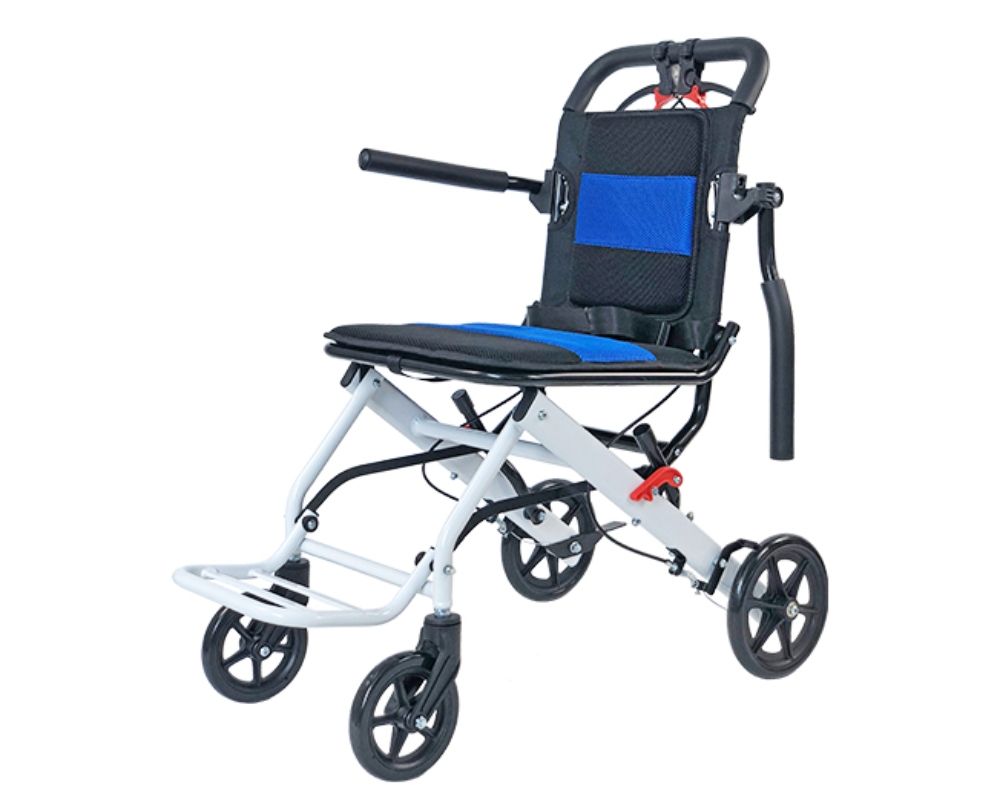
La taille de la roue et le matériau sont ici. Les roues avant plus petites supportent généralement un mouvement intérieur plus serré, tandis que les roues arrière aident à transporter la chaise en douceur sur des surfaces terminales plates. Le Xunyu Médical Fauteuil roulant de couloir d'avion de 8 pouces XY-1002A utilise des roues en PVC avant de 6 pouces et arrière de 8 pouces, une combinaison pratique pour les planchers durs, les couloirs aéroportuaires et le mouvement des couloirs étroits. La taille du produit est de 85 × 52 × 85 cm, ce qui soutient son rôle de chaise de transfert compacte plutôt qu'un fauteuil roulant de taille complète pour l'utilisation quotidienne.
Structure légère pour une manipulation fréquente
Un cadre léger a la même valeur que la largeur mince. Le personnel de l'aéroport, les soignants et les travailleurs de clinique doivent souvent changer d'équipement rapidement. Ils le déplacent des lieux de stockage vers les zones de travail. Une chaise difficile à soulever peut devenir un problème de routine. Cela se produit principalement si les travailleurs le manipulent plusieurs fois par jour.
Le XY-1002A dispose d'un cadre principal en alliage d'aluminium avec une surface peinte et un poids net de 7,6 kg. Ces caractéristiques facilitent le soulèvement, l'ajustement et le maintien pendant les shifts. Pour les acheteurs qui examinent des appareils de mobilité conçus pour les aéroports 2026, de tels détails de poids se révèlent plus utiles que des déclarations vagues sur la facilité de mouvement. Les chiffres réels aident les groupes d'achat à décider si la chaise fonctionne bien pour l'utilisation des employés, les espaces de stockage, l'emballage des véhicules et les tâches avec plusieurs arrêts.
Transfert latéral plus sûr avec accoudoirs pliables et ceinture de sécurité
Une différence clé entre un fauteuil de transport standard et un fauteuil roulant d'allée d'avion est le processus de transfert. Les passagers peuvent devoir passer de leur fauteuil roulant personnel dans le fauteuil d'allée, puis du fauteuil d'allée dans le siège de l'avion. Cela peut se produire dans un espace restreint, avec des mouvements corporels limités et souvent sous pression lors de l'embarquement. Un appuie-bras fixe peut bloquer la voie de transfert, en particulier pour les utilisateurs âgés, les voyageurs après la chirurgie et les passagers avec une force inférieure du corps réduite.
Les accoudoirs pliables aident à résoudre ce problème. Ils ouvrent le côté de la chaise afin que les assistants puissent soutenir le mouvement latéral plus facilement. La conception ne supprime pas le besoin d'une assistance formée, mais elle peut rendre le chemin de transfert plus clair et réduire les torsions inutiles. Pour les équipes d’assistance aux fauteuils roulants des aéroports, ce détail affecte à la fois la confiance des utilisateurs et l’efficacité du service.
Le XY-1002A comprend des accoudoirs pliables, ce qui facilite les transferts latéraux pour les utilisateurs et les assistants. Les ceintures de sécurité sont une autre caractéristique essentielle mais importante. Dans les transferts de courte distance, l'utilisateur peut dépasser des écarts de plancher, de petits seuils ou des changements de vitesse de marche. Une ceinture aide à maintenir le passager correctement positionné pendant le mouvement.
Confort du siège pendant l'attente et les courts transferts
Le temps de transfert aéroport n'est pas toujours court dans la pratique. Les passagers peuvent attendre à la porte, faire une pause pendant l'embarquement ou rester assis pendant que le personnel coordonne l'assistance. Un siège dur et mal ventilé peut sembler acceptable pendant une minute, mais il peut devenir inconfortable lors d'attentes répétées et de mouvements.
C’est pourquoi le matériel du siège mérite une attention dans les achats B2B. Pour les équipes d’assistance aéroportuaire, le confort n’est pas seulement un détail de l’expérience utilisateur. Cela affecte la coopération pendant le transfert, la posture de l’utilisateur et le sentiment de sécurité du passager. Le tissu respirant peut réduire l'accumulation de chaleur, en particulier dans les terminaux bondés ou les climats chauds. Il convient également mieux aux passagers âgés qui peuvent rester assis plus longtemps que prévu.
Le XY-1002A utilise un coussin de siège respirant noir et bleu. Cette fonctionnalité s'adapte au rôle du produit en tant que fauteuil roulant d'allée d'avion de courte distance et fauteuil roulant de transfert aéroport. La chaise n'est pas positionnée comme une chaise de mobilité personnelle toute la journée. Il convient mieux pour l'embarquement, le transfert de cabine, le mouvement de clinique et les situations de soins de voyage où le poids léger, la taille compacte et la manutention sûre comptent le plus.
Comment les acheteurs B2B devraient choisir des appareils de mobilité conçus pour les aéroports
Le choix des dispositifs de mobilité conçus pour les aéroports 2026 ne devrait pas se fonder uniquement sur le prix ou l'apparence générale du produit. Le travail de transfert aéroport est répétitif, sensible au temps et très visible. Une chaise faible peut créer des problèmes de sécurité, des retards de service ou un inconfort pour l'utilisateur. Une chaise bien adaptée, en revanche, peut favoriser une assistance à l'embarquement plus fluide et réduire la pression sur le personnel.
Vérifiez la route de transfert réelle avant de choisir un modèle
La première étape consiste à revoir l'itinéraire opérationnel. La chaise ne sera-t-elle utilisée qu'à l'intérieur de la cabine de l'avion, ou aussi dans les étages des terminaux, les cliniques, les maisons de retraite, les zones de navette et les établissements de soins? Un fauteuil roulant dans l'allée d'avion pour le transfert de terminal et de cabine doit être assez léger pour une manipulation fréquente mais assez fort pour une utilisation quotidienne répétée.
L'alliage d'aluminium est souvent un matériau approprié car il maintient le cadre plus léger que de nombreuses options en acier tout en offrant une résistance pratique pour l'utilisation en transport. Le XY-1002A utilise un cadre principal en alliage d'aluminium, qui soutient son utilisation dans le transfert aéroport et le mouvement de soins à courte distance. Son poids net de 7,6 kg facilite également la gestion des assistants pendant le travail quotidien.
Examiner les limites d'espace, les besoins de pliage et les conditions de stockage
L'espace est l'un des problèmes les plus fréquents dans les aéroports et les environnements de soins. Les couloirs de cabine, les entrepôts, les ascenseurs et les coffres des véhicules influent tous sur le choix des produits. Un fauteuil roulant peut sembler approprié sur une photo de produit, mais les équipes d'achat doivent toujours vérifier les dimensions réelles, la méthode de pliage et la commodité de stockage.
Le XY-1002A mesure 85 × 52 × 85 cm et prend en charge le stockage pliable rapide. Pour les acheteurs travaillant avec des salles d'équipement limitées ou des véhicules mobiles de soins, le stockage compact peut réduire les frottements quotidiens. Un fauteuil roulant pliable manuel pour les voyages aériens ne devrait pas créer de problèmes de manutention supplémentaires après le transfert des passagers.
Comparer les options manuelles et alimentées par cas d'utilisation
Les fauteuils roulants à moteur sont importants pour le mouvement indépendant, mais ils ne sont pas toujours le choix le plus simple pour le transfert d'allée d'avion. Les aides à la mobilité alimentées par batterie peuvent impliquer l'homologation de la compagnie aérienne, la protection de la batterie et la manutention du transport. Ces étapes sont nécessaires pour la sécurité, mais elles peuvent ne pas répondre à tous les besoins de transfert court.
Un fauteuil roulant à couloir manuel évite ces problèmes de batterie pour les travaux de transfert de cabine et d'aéroport. Il peut également être partagé plus facilement par les aéroports, les cliniques, les maisons de retraite et les fournisseurs de services de soins. Pour une utilisation à courte distance, le contrôle manuel permet aux assistants de manipuler directement, de prévoir les mouvements et de stocker plus facilement. Cela fait d'un fauteuil roulant léger pour les voyages à l'aéroport une option pratique pour de nombreux environnements de service B2B.
Associer les spécifications du produit aux exigences de sécurité de l'utilisateur
La capacité de charge doit toujours être examinée soigneusement. Le XY-1002A est répertorié avec une capacité de poids de produit de 110 kg. Pour les équipes d'achat, ce chiffre devrait être comparé au groupe d'utilisateurs attendu, à la politique de service local et au profil des passagers. Si une installation dessert souvent des utilisateurs au-dessus de cette plage, un modèle différent devrait être envisagé. La sélection responsable des équipements commence toujours par des conditions de fonctionnement réelles.
Les autres détails devraient également être examinés ensemble et non séparément. Les accoudoirs pliables soutiennent le transfert latéral. Une ceinture de sécurité aide à maintenir l'utilisateur positionné pendant le mouvement. Les sièges respirants améliorent le confort pendant l'attente. Les roues en PVC conviennent aux planchers intérieurs durs. Un cadre en alliage d'aluminium léger soutient la manipulation du personnel. Lorsque ces détails fonctionnent ensemble, la chaise devient plus utile dans les aéroports et les services de soins.
Pourquoi Xunyu Medical XY-1002A convient aux besoins de transfert d'aéroport et de cabine
Spécifications pratiques pour les travaux de transfert aéroport
Le Xunyu Médical XY-1002A a un cadre principal en alliage d'aluminium avec une surface peinte, aidant à réduire le poids de manutention tout en conservant la structure adaptée à une utilisation répétée de transfert à courte distance. Son poids net est de 7,6 kg, ce qui facilite le déplacement, le stockage et le repositionnement des services quotidiens.
Le fauteuil roulant mesure 85 x 52 x 85 cm et a une capacité de charge de 110 kg. Il utilise des roues en PVC avant de 6 pouces et arrière de 8 pouces, une combinaison pratique de roues pour les planchers durs intérieurs, les couloirs de l'aéroport, les zones d'embarquement et les itinéraires de mouvement étroits. Ces spécifications soutiennent son rôle de fauteuil roulant compact pour les aéroports plutôt qu'un fauteuil de mobilité quotidienne de taille complète.
Fonctionnalités axées sur le transfert pour une utilisation plus sûre
Le XY-1002A dispose d'appuie-bras pliables. Ceux-ci s'avèrent utiles lorsque les passagers ont besoin de transferts latéraux. Ces transferts se font entre un fauteuil roulant personnel, un fauteuil d'allée, un siège d'avion ou un siège de soins. Cet élément aide les assistants à diriger les mouvements plus fluidement. Il réduit également le torsion évitable lors des transferts supportés.
La chaise comprend également une ceinture de sécurité. Il comprend également un coussin de siège respirant noir et bleu. La ceinture de sécurité assure que l'utilisateur reste correctement positionné lors de courts mouvements. En même temps, le coussin respirant favorise le confort pendant les temps d'attente, les procédures d'embarquement et les retenues de transfert. Ces aspects rendent le modèle adapté à l'assistance en fauteuil roulant à l'aéroport. Ils fonctionnent également bien pour les déplacements cliniques, les soins de voyage pour personnes âgées et les situations supplémentaires d'aide à la mobilité à courte distance.
Pour les équipes d'approvisionnement assemblant une liste de fournitures d'aide à la mobilité aéroportuaire, le XY-1002A fournit une base de spécification solide. Il comprend un cadre léger en alliage d'aluminium, poids net de 7,6 kg, accoudoirs pliables, coussin de siège respirant, ceinture de sécurité, roues avant de 6 pouces, roues arrière de 8 pouces et capacité de charge de 110 kg. Les acheteurs qui recherchent des détails du modèle ou une aide à la sélection peuvent atteindre Xunyu Médical via la page de contact officielle.
Conclusion
Un fauteuil roulant dans l'allée d'un avion devrait être jugé en fonction de sa capacité à supporter les mouvements étroits, le transfert latéral sûr, le confort assis, la manipulation du personnel et le stockage dans des environnements réels d'aéroport ou de soins. En 2026, l’assistance en fauteuil roulant plus sûre et une meilleure gestion de l’aide à la mobilité restent des sujets importants dans les voyages aériens. Pour les acheteurs B2B, le meilleur choix n'est pas seulement compact; Il doit également être stable, pratique et clair dans les spécifications. Xunyu Medical XY-1002A répond à ce besoin avec un cadre en alliage d'aluminium de 7,6 kg, des accoudoirs pliables, un siège amorti respirant, une ceinture de sécurité, des roues en PVC avant de 6 pouces et arrière de 8 pouces et une capacité de charge de 110 kg.


