

No-Drill Bedside Rails What Elderly Care Buyers Should Check
Time : Oct 03, 2026 Vue : 71
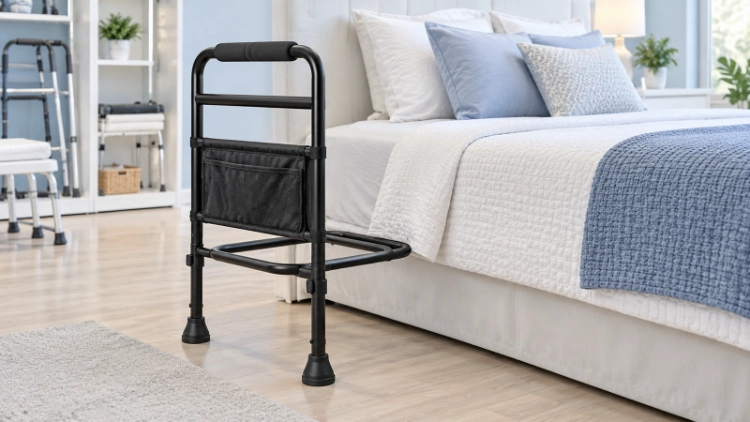
A bedside rail sample is easiest to assess when the intended bed is available. The mattress edge, frame access and space beside the bed all affect installation. A rail that looks compact in a product photograph may put its grip in an awkward position once a topper and ordinary bedding are fitted.
For elderly-care purchasing in Malaysia, this makes bed details part of the initial enquiry. The care team also needs to identify the person and task for which support is being considered. “No-drill” describes an installation feature. The selected model still has to work with the bed arrangement and the individual’s care plan.
Where the rail meets the bed
The supplier needs mattress thickness and overhang, together with photographs of accessible frame sections. A floor-supported model also requires under-bed clearance and space for its feet. These details help narrow the samples to consider; the installation instructions determine how the chosen rail is secured.
For an under-mattress base, the buyer needs to see the complete retention arrangement. Which parts are included, where do they attach and can the caregiver reach them? Mattress weight alone should not be assumed to secure the frame. A missing fitting component can matter more than a small difference in the rail’s overall weight.
An adjustable care bed introduces movement. Raising the backrest or changing the height may alter the rail’s position relative to the mattress or another frame component. Compatibility on a fixed domestic bed does not settle that question. The product must be intended for the proposed arrangement and assessed through the relevant bed movements.
Ordinary bedding belongs in the trial too. A topper changes the height of the sleeping surface, while a protector or loose sheet can affect how components sit. The care team needs to assess the installed combination under the manufacturer’s conditions. A firm showroom mattress may not reproduce what happens at the softer edge of the customer’s bed.
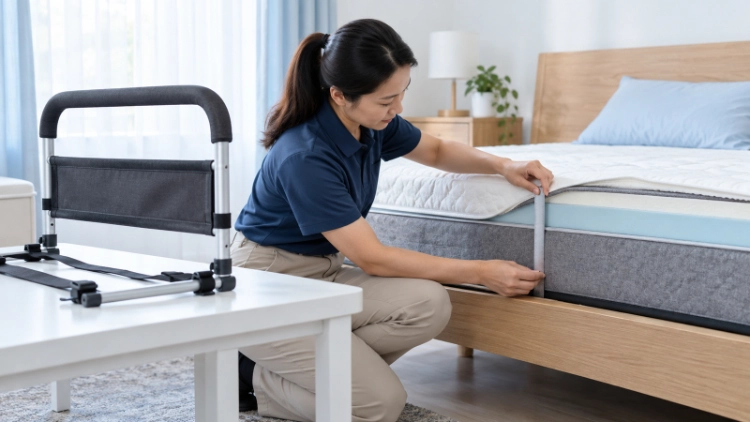
The task determines the grip position
The intended use may involve sitting up, repositioning or a transfer assessed by the care team. Each puts the person in a particular position relative to the grip. A buyer can record that intended task with the bed measurements, so the sample is reviewed for a defined purpose.
The rail should not be selected as a barrier simply because it can be fitted beside the mattress. It is not automatically a full-length guard or a fall-prevention solution. For someone likely to climb over a rail, or unable to respond safely if trapped, its use requires particular care-team attention. The individual assessment remains necessary even where the installation fits well.
Three models to examine at the sample stage
Xunyu Médical supplies XY-310, XY-316 and XY-429 removable bedside handrails. Before comparing them, the buyer should have the permitted uses and installation limits for each proposed version. Weight, grip dimensions and base construction help identify differences, but none provides a complete compatibility decision on its own.
XY-310 and removal between care tasks
XY-310 weighs 1.3 kg net per unit and has a spray-coated steel frame. A foam grip and storage bag are included in its design. Its weight is relevant when a caregiver needs to remove and store the rail, but the removal procedure also depends on access to the fitted retention components.
At the sample bed, bedding changes can be used to review that procedure. The caregiver needs somewhere to place the removed rail and a clear way to reinstall it under the instructions. Installation sheets and permissible use limits should accompany the supplied version.
XY-316 and its frame dimensions
Le XY-316 rail d'assistance au bord du lit uses a carbon-steel main frame with 1.2 mm tube thickness. The lower frame is electroplated and the upper frame spray-coated. Its 35 cm handrail and 52 cm base are dimensions to compare with the proposed bed arrangement. Nominal net weight is 1.9 kg.
The specified load-bearing capacity is 100 kg. It is a product limit to confirm for the supplied version; a user trial should follow the care assessment and instructions, rather than attempt to reproduce that load. Grip access and the fitted base still need assessment at the bed.
XY-429 and contact with the floor
Le XY-429 floor-standing bedside rail has a 55 cm base and a total height range of 83–107 cm. Nominal net weight is 2.5 kg, and specified load-bearing capacity is 136 kg. Reinforced double horizontal bars form part of its flat-tube frame; other features include a foam handle, nylon storage bag and anti-slip foot pads.
With this arrangement, the review includes both the bed connection and contact between the feet and floor. The instructions need to establish the installation and adjustment method. The available height range gives dimensions for comparison, while the assessed user’s position determines whether the fitted grip is usable.
Across the bedside handrail range, the foam grip or bag may look familiar. The base, retention arrangement and support position need model-specific review. Substituting one version for another can require a new fit assessment.
Mattress gaps can change after fitting
The opening beside a rail may look different once someone lies on the mattress. Compression, a shifted mattress or movement of the bed can alter the gap. Entrapment risks include openings within and around the rail as well as the space between it and the mattress.
Le FDA’s portable bed rail safety recommendations address mattress compatibility, retention and entrapment risks, including for people with confusion or impaired movement. They provide safety guidance rather than evidence of approval for a particular rail. Local requirements for a Malaysian order need their own review.
The care team needs to judge whether a rail is appropriate for the person. An assist rail should not become a restraint simply because it is available beside the bed. Changes to the mattress, bed or user’s condition call for another assessment.
Gap assessment should use the applicable product instructions and assessment method. If the intended combination cannot be installed correctly, the rail should not enter use on that bed. Adding improvised padding or relying on mattress pressure is not a substitute for the specified fitting arrangement.
Records for cleaning, delivery and replacement
Inspection needs to fit the daily routine. Retention components, the frame, mattress position and openings require attention; floor-supported models add foot contact. Cleaning and bed adjustment are occasions to repeat the relevant installation checks. Damaged or incompatible equipment should be taken out of use under the manufacturer’s service instructions.
Distributors also need the package dimensions for shipment planning. For XY-310, the single-unit package is 32.5 × 11 × 53 cm. XY-316 is packed at 56 × 10 × 36 cm, and XY-429 at 32 × 10 × 43 cm. The order should identify these as package measurements, alongside carton quantities and included fitting components.
Replacement grips, bags, foot pads and retention parts should be identified for the selected model. Xunyu Medical’s service team can clarify compatibility and supply terms. Local-language installation sheets and clear model labels help staff distinguish versions when supplying several beds.
Conclusion
A useful sample record identifies the rail, its fitting components and the bed and mattress assessed with it. It also records the intended support task. To find the right bedside rail for your care setting, send those bed details with the enquiry so the proposed model can be reviewed in the arrangement where it will be used.
Questions fréquentes
Q: Will a no-drill bedside rail fit any bed?
A: No. The installation method needs to suit the frame, mattress and any bed movement. A rail supplied for one bed arrangement may be unsuitable for another. The sample should be assessed with the intended bedding and all specified retention components fitted.
Q: What should Malaysian elderly-care buyers ask for with a sample?
A: The exact model, dimensions, stated load limit, installation instructions and included retention components. The sample needs assessment with the intended bed, mattress and user care plan. Cleaning instructions, language versions and replacement-part references should be retained with that model’s record.
Q: Does a higher load-bearing capacity make a rail safer?
A: The capacity figure addresses one product limit. Overall suitability also depends on installation, bed compatibility, mattress gaps and the individual assessment. It does not authorise a strength test with a person or justify using an assist rail as a restraint.


