

Underarm Crutches vs Forearm Crutches for Buyers
Time : Sep 16, 2026 Vue : 60
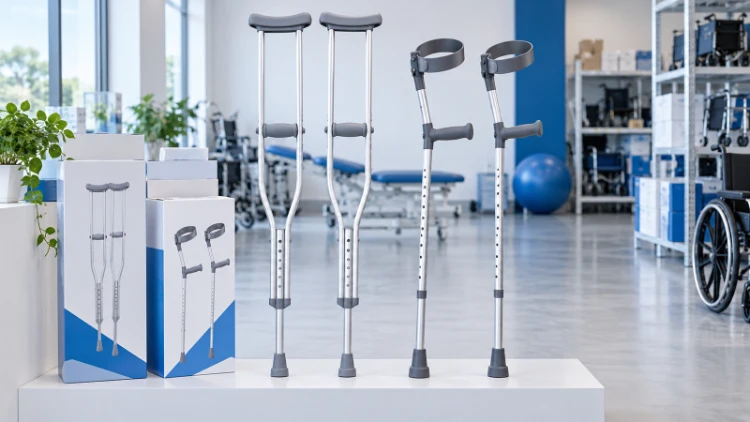
Underarm and forearm crutches are not interchangeable products with different colours. They place support and control in different parts of the body, so they create different fitting questions, instructions, replacement needs, and sales conversations. A buyer choosing a product range should start with the users and channels being served, then compare the adjustment system, size coverage, packaging, and after-sales requirements. This gives a more useful result than choosing only by appearance or unit price.
Start with the design difference
Béquilles sous les bras
Underarm, or axillary, crutches use a pad below the armpit and a handgrip lower on the frame. They are common in short-term recovery and general medical supply channels, where a dealer may need several size options and clear fitting instructions. The product should never be presented as something a user can load through the armpit. The pad, handgrip, and height settings need to work together so the user can follow professional fitting guidance.
Forearm crutches
Forearm crutches use a cuff around the forearm and a handgrip below the elbow. They may suit rehabilitation or longer-term mobility programmes that use a different pattern of support, subject to professional assessment. A cuff also creates its own questions about position, attachment, adjustment, and replacement. A catalogue should explain those differences instead of treating a forearm model as a smaller version of an underarm model.
Compare fit and adjustment
What to check on an underarm model
Le XY-925 aluminum crutch is available in Small, Medium, and Large sizes. It has nine foot-tube adjustment levels and five grip positions, with tube thickness options of 1.0 mm, 1.1 mm, and 1.2 mm. A buyer should list these as separate fields in the RFQ and sample approval record. Test several positions on both crutches, confirm that each spring button seats fully, and check that paired units can be set to equal height. The anti-slip rubber pad should also be checked for attachment and damage.
What to check on a forearm model
The XY-937 is a foldable forearm crutch with an anodized aluminium leg, handgrip, rubber tip, and spring-button adjustment. Its fitting information describes an approximately 30-degree elbow bend when the handgrip is set correctly. Buyers should confirm the exact adjustment range, cuff attachment, folding action, and lock behaviour for the quoted version. These checks describe the product; they do not prove a clinical outcome or make the model suitable for every user.
Build a range for the channel
A pharmacy may need a straightforward size choice for short-term recovery. A rehabilitation centre may need more fitting support and a different balance of underarm and forearm models. A home-care distributor may value compact storage, easy identification of replacement tips, and instructions that caregivers can follow. These channel differences should determine the size mix and stock depth. They are more useful than adding several similar models without a clear role for each one.
Keep the catalogue clear
Each listing should state the design, size coverage, adjustment points, contact parts, included accessories, and intended assessment process. Avoid calling one model the best unless the project has a defined criterion. Fit limitations belong close to the product description, not hidden in a general disclaimer. A clear catalogue helps sales staff answer basic questions without turning every enquiry into a new technical investigation.
Plan packaging and warehouse work
Underarm and forearm crutches may need different inner packing, carton marks, and storage positions. Record carton dimensions, units per carton, model and size markings, and the protection provided for pads, cuffs, grips, and tips. Before a mixed shipment is approved, confirm that warehouse staff can separate the sizes without opening every carton. This reduces picking errors and makes receiving checks faster.
Match documentation to the channel
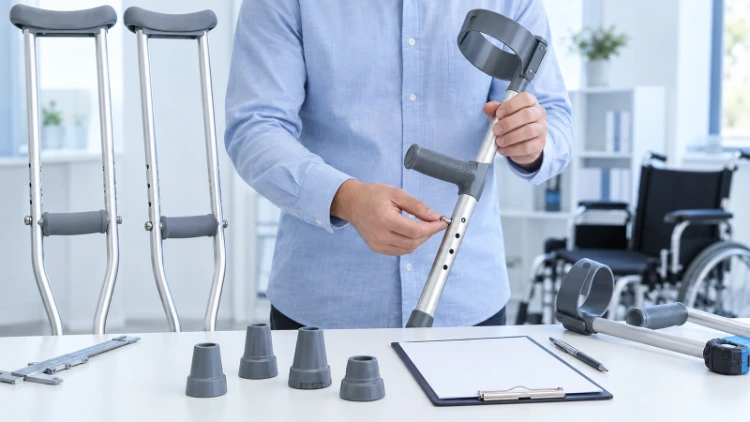
A product that is sold through a pharmacy may need a simpler size guide than one supplied through a rehabilitation centre. The manual, carton mark, product photograph, and replacement-part list should use the same model and size names. If staff in different locations handle the stock, agree on the terms used for the pad, cuff, grip, spring button, and rubber tip. Clear language prevents a sales team from promising a feature that belongs to another model.
Distributors should also decide who handles fitting questions and when a customer is referred to a healthcare professional. That decision belongs in the service process rather than being left to an individual salesperson. It gives buyers a practical way to compare suppliers: not only by the crutch supplied, but by the information and support that arrive with it.
Plan replacement parts and support
Rubber tips, pads, cuffs, and handgrips can generate frequent service requests even when the main frame is still usable. Ask for part identifiers, model compatibility, minimum spare quantities, packaging, price, and the expected supply route. Do not promise permanent availability until the manufacturer confirms the terms. Instructions should also identify which parts belong to which model; a shared description can cause the wrong spare to be sent.
The same support plan should cover fitting questions. A short manual can show the adjustment points and explain when the user should seek professional guidance. MedlinePlus recommends professional instruction and correct height adjustment for crutch users; buyers can link their own manuals to that boundary without making treatment claims.
This also makes reorder discussions more precise when demand changes by channel or season.
Approve the sample before the order
The approved sample should match the quoted model, size, material option, adjustment structure, contact parts, labels, manual, and packaging. Move each adjustment through more than one position. Compare paired units for equal height and stable settings. If the order contains several sizes, represent each size in the sample or pre-shipment inspection plan. Keep the signed specification with the purchase order so receiving staff have a practical reference.
Before placing a mixed order, compare not only unit price but also the work that follows delivery: staff training, fitting questions, carton handling, replacement-part identification, and return reasons. A model that looks economical can create more service cost if every version needs a different manual and spare-part route. Recording these requirements beside the quotation gives buyers a clearer basis for supplier comparison.
Conclusion
Underarm crutches vs forearm crutches should be a product-line decision based on users, channels, fitting responsibility, adjustment design, and after-sales support. Underarm models may need a broader size matrix and pad-focused checks, while forearm models require clear cuff, grip, adjustment, and folding information. Recording these differences before sampling makes the delivered range easier to sell, store, explain, and support.
Buyers can explore the Catégorie de béquilles médicales Xunyu et utilisez le service enquiry for questions about models, size mixes, packaging, or spare parts. For a new sourcing project or a more specific requirement, start a crutch sourcing discussion with the Xunyu team.
Questions fréquentes
Q: What is the main difference between underarm and forearm crutches?
A: Underarm crutches use a pad below the armpit, while forearm crutches use a cuff around the forearm. The two designs therefore require different fitting and replacement checks.
Q: Which type should a distributor stock?
A: Stock the design and size range that match the channel, user scenarios, professional fitting process, and support resources available to your customers.
Q: What should buyers compare besides the crutch frame?
A: Compare adjustment points, contact parts, size coverage, manuals, carton data, spare-part terms, sample approval, and the work required after delivery.


