

Wheelchair Seat Width and Why It Matters
Time : Oct 26, 2026 Visualizzazione : 8
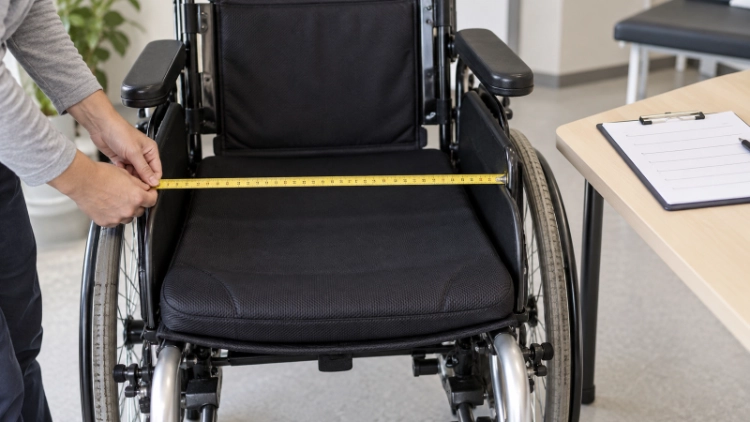
Wheelchair seat width is the usable horizontal space across the seat, usually measured between the side supports or armrest structures. It affects body support, access to the wheels, pressure distribution, transfers, clothing clearance, and the overall width of the chair. A wider number is not automatically better. Too little space can create contact and discomfort, while excessive space may reduce lateral support and make propulsion or positioning harder.
For distributors and institutional buyers, seat width is both a fit measurement and a range-planning decision. The number should be read with seat depth, armrest position, frame design, rear-wheel location, and overall chair width. It also needs to match the actual product version. A generic family name may cover more than one seat size.
Seat Width Is Not the Same as Overall Width
The Seat Measurement Describes the Occupied Space
Seat width refers to the space available to the seated person. The measurement point matters because upholstery, side guards, frame tubes, and removable cushions can change the usable area. Buyers should ask whether a published dimension is measured between armrests, between side panels, or across the fabric. A small difference in method can cause confusion when two supplier sheets are compared.
Xunyu manual wheelchair listings show several seat-width options, including 41 cm, 44 cm, 45 cm, 46 cm, and 47 cm. Each figure belongs to a specific model or configuration; it should not be treated as a standard size for the whole range. The categoria di prodotto sedia a rotelle is therefore a starting point for model-level confirmation, not a substitute for the quoted dimensional sheet.
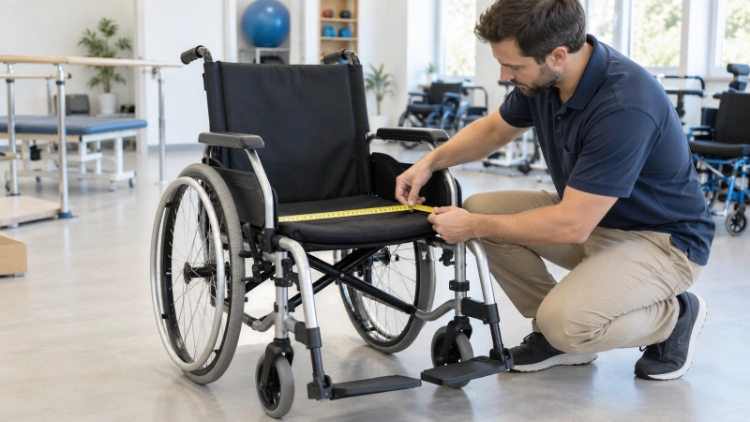
Frame and Wheels Add to the Chair’s Footprint
Overall width includes more than the seat. Frame tubes, armrests, wheel position, handrims, and hardware add space on both sides. A self-propelled chair with 24-inch rear wheels may have a larger external footprint than a transit chair with the same seat width. This matters at doors, lifts, bedside spaces, vehicle ramps, and storage racks.
Procurement documents should keep seat width and overall width in separate fields. Combining them under one heading such as wheelchair width invites errors. It is also useful to record folded width for models that will be transported or stored frequently.
Fit Requires More Than Adding Clearance
Too Narrow and Too Wide Create Different Problems
A narrow seat may press against the body or clothing and can complicate transfers. A seat that is much wider than necessary may leave the user without useful side support and can change access to the handrims. The correct allowance depends on the assessment method, cushion, clothing, posture, and clinical needs. Buyers should avoid publishing a universal rule as if it suits every user.
Il WHO Wheelchair provision guidelines treat assessment, fitting, training, and follow-up as connected parts of wheelchair provision. That is an important boundary for commercial content. A supplier can provide dimensions and product information, but individual fit decisions should be made by qualified personnel using the relevant service process.
Seat Width Works With Seat Depth and Back Support
Seat depth affects where the front edge sits behind the knees, while backrest height and angle affect trunk support. Footrest length influences lower-leg support. A correct width cannot compensate for an unsuitable depth or footrest setting. This is why a buyer comparing models should request a full dimensional drawing rather than one headline number.
Manual wheelchair models also differ in seat depth, backrest height, and wheel size. Those dimensions belong in a model matrix because chairs that look similar in photographs may serve different dimensional requirements.
Buyers Need a Consistent Measurement Method
A sample-approval form should state exactly where the seat width is measured. The same method must be used when the production sample, pre-shipment unit, and received goods are checked. If upholstery bows inward or side components reduce the usable space, a frame-level measurement alone may not describe the seated area.
Buyers can add a simple drawing to the specification sheet. Mark points A and B for seat width, C and D for depth, and separate arrows for overall and folded width. The drawing reduces language ambiguity and helps warehouse or inspection staff repeat the check without interpreting a paragraph of text.
Model-specific product information remains essential. For example, the XY-809 manual wheelchair lists dimensions, wheel details, brakes, and folding construction for that product. A buyer should still confirm the quoted configuration, because optional parts or product updates may change the exact specification.
Seat Width Also Affects Product Line Planning
A distributor does not need to treat every possible width as a separate market segment, but it should know which sizes are stocked, ordered on request, or unavailable. Sales teams need clear wording so they do not promise suitability from age, body weight, or appearance alone. Seat width and load capacity answer different questions.
Institutional buyers may also need consistent widths for storage or room layouts. That operational preference should not replace individual assessment. A care facility can standardize documentation and maintenance while still allowing different sizes where users need them.
The product page, carton label, instruction manual, and invoice description should use the same model and width notation. When a model is available in several sizes, a suffix or configuration code can prevent a warehouse from shipping the wrong version. Buyers comparing the wider Xunyu Medical product range should request a current dimensional table for the exact models under review. This is particularly useful for distributors serving Malaysia and Singapore, where apartment entrances, clinic corridors, lift dimensions, and compact storage areas can place different limits on seat and overall width.
Sample records should also state whether measurements were taken with the cushion installed and the upholstery under normal tension. That small note makes later inspection more repeatable. It also helps a supplier explain why a soft seat surface may not match a simple frame-to-frame measurement.
Domande frequenti
Q: How is wheelchair seat width measured?
Una: It is generally measured across the usable seat area, but suppliers may use different reference points. The specification should state whether the measurement is between armrests, side guards, or frame elements. A drawing is more reliable than a width value presented without a defined method.
Q: Does a wider wheelchair seat provide more comfort?
Una: Not automatically. Extra width may provide clothing clearance, but too much space can reduce lateral support and change access to the handrims or armrests. Comfort also depends on seat depth, cushion, posture, back support, and the individual’s assessed needs.
Q: Is seat width the same as wheelchair width?
Una: No. Seat width describes the seated space. Overall wheelchair width includes the frame, armrests, wheels, handrims, and external hardware. Both measurements should appear separately when buyers check door clearance, vehicle loading, storage, and user fit.
Q: Can body weight be used to choose seat width?
Una: Body weight alone does not define width. People with the same weight can have different body dimensions and support needs. Load capacity must be checked separately, while seat size should follow an appropriate measurement and fitting process.
Q: What wheelchair dimensions should a buyer request besides seat width?
Una: Request seat depth, seat-to-floor height, backrest height, overall width, folded width, overall length, footrest adjustment range, wheel diameter, and load rating where applicable. The exact list depends on the chair type and intended setting.
Seat width is a basic dimension, but it is not a shortcut for complete wheelchair selection. Buyers get better results when the measurement method is defined, related dimensions are recorded, and each quoted model is tied to a clear configuration. That discipline helps both fitting teams and commercial teams work from the same product information. For a seat-width comparison, include the measurement method, overall-width limit, and exact model in the discussion. Send those details to Xunyu Medico when reviewing a configuration for a home-care, rehabilitation, or medical-distribution range.


