
The Ultimate Guide: How to Properly Measure and Adjust Underarm Crutches
Time : Apr 20, 2026 表示回数 : 65

Clinical recovery protocols often overlook a critical phase: the precise calibration of mobility aids. Patients routinely leave medical facilities with standard walking devices, only to experience severe axillary pain or wrist numbness within 48 hours. This complication arises systematically. Users lean excessively into their medical rehab crutches without understanding the necessary biomechanics. Accurate sizing, however, remains the determining factor for daily comfort, structural safety, and rehabilitation speed. Mitigating secondary nerve compression demands strict adherence to measurement standards. The following comprehensive framework details the proper methodology for fitting these devices, avoiding pervasive operational errors, and selecting optimal equipment for sustained clinical support.
The Critical Impact of Correct Crutch Sizing on Recovery
Initial engagement with a lightweight walking aid often prioritizes immediate mobility over mechanical precision. Yet, unilateral weight-bearing introduces profound shifts in human biomechanics. Equipment configured even slightly above or below the required threshold fundamentally destabilizes the user, precipitating entirely preventable musculoskeletal stress.
Preventing Nerve Damage and Muscle Strain
The axillary region houses an intricate network of vascular structures and nerves. Should an aluminum underarm crutch be elevated beyond correct specifications, the entire somatic load—frequently exceeding 150 pounds—transfers directly onto these vulnerable tissues. Such acute pressure severely restricts localized circulation. Consequently, axillary nerve compression manifests as “crutch palsy,” characterized by peripheral tingling, acute numbness, or transient motor function loss in the extremities.
Conversely, a deficient device height necessitates chronic spinal flexion. This sustained hunched posture generates intense strain across the lumbar and deltoid muscle groups. Optimal calibration mandates that the primary kinetic load transmits through the upper extremities, which consequently necessitates a highly comfortable hand grip to diffuse the kinetic impact of routine ambulation.
Maintaining Balance on Uneven Surfaces
Unilateral stance instantaneously alters the body’s center of gravity. Failure to accurately adjust crutch height fundamentally degrades balance. An elevation discrepancy of merely a single inch forces the user’s mass posteriorly, elevating the probability of backward falls during incline navigation or threshold crossings.
Shortened tools produce the opposite effect, accelerating forward momentum dangerously. Pairing such dimensional inaccuracies with low-friction environments—such as glazed tiles or precipitation-slicked concrete—exponentially increases secondary fracture risks. Pinpointing the exact structural height preserves a centralized, vertical posture. It is this precise verticality that forces the base elements into flush, planar contact with the substrate, delivering the maximum friction coefficient necessary for secure transit.
Step-by-Step Crutch Size Guide for Patients
Achieving dimensional accuracy is not an estimation; it is a rigid physical calibration. Measurements must correspond to specific anatomical landmarks rather than gross physiological height. Clinical professionals rely upon a definitive crutch size guide to establish baseline stability parameters for patient mobility.
Determining the Overall Height of the Frame
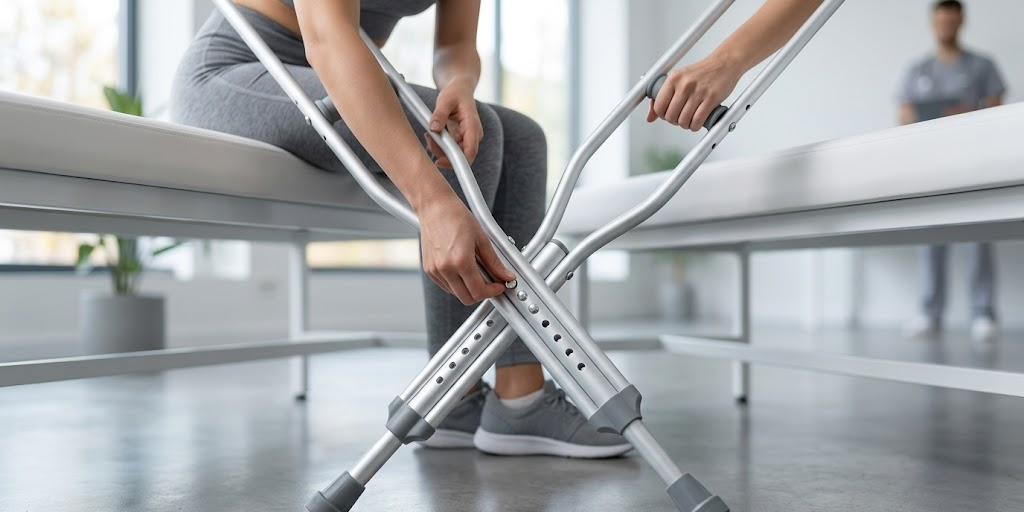
Standard orthopedic protocol dictates the “two-finger” clearance metric for an aluminum underarm crutch. The procedure requires an erect stance, incorporating the primary footwear designated for the rehabilitation phase. Variances in shoe sole depth radically alter the necessary clearance compared to barefoot measurements. Upon positioning the frame, the superior axillary pad must maintain a gap of approximately 1 to 2 inches—equivalent to dual horizontal digits—inferior to the actual axilla.
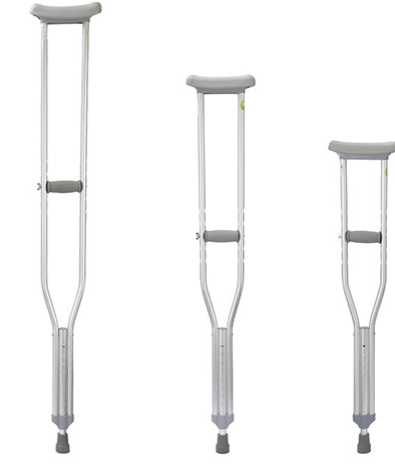
Historical inventory models often imposed a generic dimension, forcing patients to accept suboptimal structural alignments. Addressing this systemic flaw, the Xunyu 医療 XY-925型 architecture incorporates three precise dimensional tiers: Small (945-1143mm), Medium (1145-1348mm), and Large (1345-1548mm). Selecting an initial chassis proportional to the user’s basic skeletal profile ensures subsequent micro-adjustments yield unparalleled accuracy.
Positioning the Hand Grips for Weight Bearing
Securing the primary frame necessitates an immediate transition to palmar interface positioning. The kinetic burden rests upon the forearms and wrists, bypassing the shoulder girdle entirely. With the upper limbs suspended neutrally, the horizontal axis of the grips must intersect identically with the deep transverse crease of the wrist. Upon active engagement, the elbow joint must demonstrate a flexion angle spanning between 15 and 30 degrees strictly.
This specific angular tolerance facilitates triceps brachii activation, generating the sheer mechanical force required for suspension. Rigidly straight arms transmit destructive impact forces directly into the articular cartilage of the elbow. Conversely, acute flexion induces rapid muscular exhaustion. To resolve this, the Xunyu Medical XY-925 deploys a dedicated 5-level grip adjustment matrix. This engineering enables diverse limb lengths to lock into an exact ergonomic threshold, sustaining a comfortable hand grip throughout prolonged weight-bearing cycles.
Key Features to Look For in Quality Medical Walking Devices

Dimensional compliance represents merely the initial phase of mobility management. The metallurgical composition and structural engineering of the apparatus govern operational security across residential and commercial terrains. Substandard alloys inevitably deform under sustained cyclic loading, generating severe physiological fatigue profiles.
-
Customizable Structural Integrity: Legacy steel frameworks impose substantial deadweight, precipitating rapid exertion limits in geriatric and adolescent demographics. An industrial-grade lightweight walking aid must supply absolute rigidity independent of excessive mass. The XY-925 utilizes a specialized fog-silver aluminum alloy. Crucially, it provides highly targeted tube thickness stratifications: 1.0mm, 1.1mm, and 1.2mm. Consequently, both a 120-pound rehabilitation patient and a 220-pound bariatric user receive mathematically appropriate load-bearing support without extraneous gravitational drag.
-
Superior Ground Traction: The basal terminus acts as the singular physical interface with the navigational plane. Economy variants frequently deploy rigid thermoplastic tips devoid of frictional capacity. Implementation of a rigorously tested anti-slip crutch mechanism is mandatory. Engineered thick rubber foot pads exponentially increase the coefficient of friction against polished ceramics and lubricated asphalt, guaranteeing locomotive stability during critical vulnerability windows.
-
Granular Adjustability: Anatomical dimensions defy standardized whole-number increments. Limited adjustment apertures frequently trap patients in misaligned intermediate states. Superior engineering demands micro-adjustment capability. The XY-925 integrates a sophisticated 9-level foot tube adjustment protocol. This allows clinical personnel to adjust crutch height to the exact spatial coordinate demanded by individual postural geometry.
-
Aesthetic Integration: Convalescence introduces documented psychological friction. Visibility of overtly clinical apparatus frequently triggers negative psychological burdens. A contemporary aluminum underarm crutch, treated with a minimalist fog-silver finish, shifts the visual paradigm toward advanced mobility technology, actively distancing the user from institutional medical aesthetics.
Common Mistakes to Avoid During Your Rehabilitation
Premium hardware cannot negate the consequences of deficient kinetic execution. Regardless of calibration perfection, flawed ambulation mechanics will rapidly synthesize pain vectors and escalate fall probabilities. Orthopedic specialists catalog identical operational failures across diverse patient populations continuously.
-
Axillary Weight-Bearing: While previously noted, this error demands reiteration due to its prevalence. Passive resting upon the superior axillary mounts is strictly prohibited. The sub-arm region must maintain microscopic clearance or minimal contact. Drive the kinetic force strictly through the palmar surface. Should localized palmar pain develop, transitioning to a model equipped with a more comfortable hand grip constructed from high-density elastomeric foam becomes necessary.
-
Neglecting Basal Friction Degradation: Operating with compromised basal tread mirrors the danger of deteriorated vehicular tires. Weekly inspection of the anti-slip crutch terminus is a non-negotiable safety protocol. Should the vulcanized rubber exhibit severe abrasion or structural fissuring, immediate component replacement is required. Surface slippage remains the primary catalyst for severe secondary trauma.
-
Cervical Flexion and Visual Fixation: Initial deployment of medical rehab crutches often induces a reflexive downward visual fixation toward the lower extremities. This action instantly distorts the cervical spine alignment and alters the center of mass. Maintaining a neutral cranial position, projecting the visual field approximately 15 feet forward, is imperative. This stabilizes the spinal column and enables proactive environmental hazard detection.
-
Manual Load Carriage: Safe operation of a lightweight walking aid mandates bilateral manual engagement without exception. Transporting ancillary items in one’s hands during transit severely breaches safety protocols. Logistic requirements must be solved utilizing integrated frame storage, lumbar packs, or dorsal carriers to ensure uninterrupted grip integrity.
結論
Lower-extremity rehabilitation requires strategic patience synchronized with precise mechanical support. Executing a rigorous crutch size guide protocol neutralizes weeks of impending axillary nerve compression, structural misalignment, and hazard risks. The fundamental doctrine remains absolute: weight transfers through the hands, elbows sustain moderate flexion, and axillary clearance is preserved. Integrating a highly engineered aluminum underarm crutch into this protocol supplies the definitive biomechanical foundation necessary for accelerated tissue repair. Acceptance of compromised, poorly calibrated medical assets is clinically unacceptable. For organizations and patients requiring maximum operational safety and advanced material aesthetics, professional-grade mobility solutions are mandatory. Contact Xunyu Medical to procure strictly vetted walking aids and establish a secure, mathematically precise trajectory toward complete structural recovery.