

How to Compare Folding Wheelchairs for Clinics and Home Care
Time : Oct 01, 2026 조회수 : 68
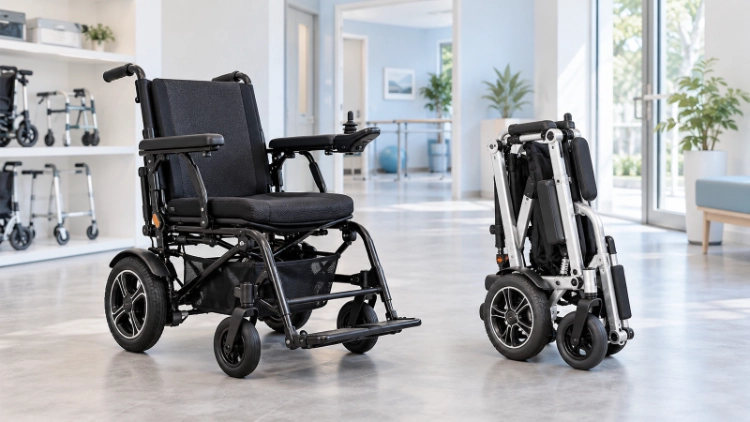
Two folding wheelchairs can look much alike when parked beside each other. During a demonstration, the differences become easier to see. One may require an accessory to be removed before folding; another may leave it attached. A quoted folded width gives no indication of how many steps are involved or where the loose parts will go.
For a clinic buying folding wheelchairs, that extra handling may occur only when equipment is put away. A home-care customer taking the chair to appointments faces it on each journey. The sample comparison needs to cover the whole sequence with the supplied accessories, including getting the chair ready for use again.
Accessories can change the folded setup
For the demonstration, the sample needs its ordinary-use configuration: the quoted cushion, footrests, battery and other fitted accessories. From there, the handler can follow the exact model’s folding instructions. On an electric chair, any power or battery precautions belong in that sequence.
A removable footrest leaves the caregiver carrying a second piece. At the destination, it has to go back on the chair. The buyer needs to see that step as well as removal, with enough room to work beside the vehicle or storage position. In a clinic, a separate accessory needs a place where the next staff member can find it.
Folded wheelchair dimensions need a short description of the measured setup. Were the footrests attached? Was the cushion left on the seat? A battery removed for the measurement is another detail to record. The sample and quotation can then be compared on the same basis, including any parts that travel separately.
The measurements recorded for that trial belong with the sample configuration. If a supplier later changes an accessory or battery, staff can see whether the original space assessment still applies. This is especially useful for dealers supplying several similar-looking versions.
At the vehicle opening
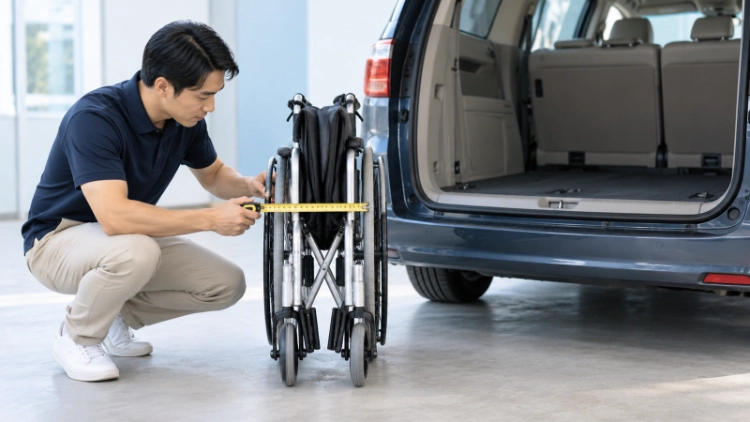
The folded chair may lie on its side in the boot, yet need a different orientation to pass through the opening. The opening needs its own measurement.
With the sample folded as instructed, the usual handler can assess the proposed loading position. There needs to be room to take hold of the frame and clear the boot lip. The model’s instructions need to identify the lifting method, so the demonstration uses the correct points. If the movement is difficult, the buyer can record exactly where: reaching the frame, raising it over the lip or lowering it inside.
The dealer can retain vehicle measurements and the accessory setup used, instead of relying on a customer’s estimate that the boot is large enough. A chair may fit inside while still being awkward to lift through the available opening.
Weight differences between electric configurations
Repeated lifting is a reason to examine the actual configuration. Xunyu 의료 offers aluminum and carbon-fiber electric wheelchair versions with different nominal weights. The sample record should identify the fitted battery and accessories.
The aluminum XY-D02L has a nominal net weight of 21 kg. The XY-D02L Pure Carbon Fiber lightweight electric wheelchair is a 15 kg net configuration with a carbon-fiber main frame. When comparing these versions for vehicle use, the buyer can assess both at the same loading position. The same setup makes the lifting difference easier to assess.
The battery box on the carbon-fiber version is quick-detachable, allowing charging away from the chair. Removal creates a separate item to carry. Its lifting armrests and quick-fold mechanism can also be demonstrated during the trial, including how the frame is secured after reopening. Any removal or lifting procedure needs to follow the model’s instructions.
The carbon-fiber configuration uses two 150 W brushless motors, with 8-inch front and 12-inch rear PU honeycomb wheels. The proposed route needs to be considered separately, using the operating limits specified for this model. A route with a kerb or slope requires that review even when the chair folds neatly for the car journey.
Dimensions for the chair and the shipment
On the carbon-fiber model, the folded chair measures 56 × 29 × 78 cm. The package is 58 × 38 × 83 cm. A home-care customer receives the chair after unpacking, whereas the dealer receives stock in cartons. The warehouse therefore needs the package dimensions for boxed stock.
The quotation can retain both measurements, clearly labelled with length, width and height. The packing figure belongs with the freight calculation. The folded figure belongs with the accessory setup demonstrated to the customer. Keeping these details together also helps receiving staff identify an unexpected configuration at delivery.
The chair still needs to suit the user
Within the 휠체어 제품군, a clinic may be considering a manual chair pushed by staff, while a home-care enquiry concerns powered movement. These uses need different demonstrations. For an electric version, the user and caregiver need instruction on the controls and charging arrangement as well as folding.
The WHO wheelchair provision guidelines include assessment, fitting, training and follow-up. Seating width, posture, foot support and the intended user’s ability to operate the chair need assessment by appropriately trained personnel. A dealer’s vehicle demonstration can address handling, but it cannot replace that individual assessment.
The route through the clinic or home matters with the chair open. A doorway measurement taken for folded storage cannot establish access during use. For an electric chair, the charging location also belongs in the planning, particularly if someone will remove and carry the battery to it.
Reopening and handover
Reopening brings the sample back to the configuration in which it will be used. The instructions need to explain how the fully opened frame is recognised and its securing mechanism confirmed. Any detached components have to be refitted under the same model-specific procedure before use.
A staff member learning the mechanism may pause at a step the salesperson completes without hesitation. The buyer can ask for that step to be demonstrated again, then give the usual handler time to repeat it. Difficulty reaching a latch in the available space is a different issue from unfamiliarity with the sequence. Both belong in the review.
Shared equipment needs a repeatable handover. The next staff member should be able to find the chair’s accessories and recognise the complete setup. Where versions differ, model identification belongs on the storage record as well as the instruction sheet.
From the approved sample to delivered stock
The purchase specification should retain the details established during review: model version, battery option where applicable, accessories, dimensions and weight basis. This gives receiving staff a reference for the shipment. Transit damage and configuration mismatches need a record before stock is released.
The folding wheelchair supplier also needs those identifiers for replacement enquiries. A footrest or locking component has to match the version supplied, as do batteries and chargers. Part references, prices, minimum quantities and lead times should accompany the support agreement. A general promise of spare parts leaves too much to resolve later.
For orders including items from the broader mobility-aid collection, the wheelchair specification can be retained as a separate record. This helps staff trace the chair and its accessories when several products arrive together.
결론
A comparison is ready to discuss with the supplier when the sample record explains the fitted accessories, weight basis and any handling difficulties. To ask for a wheelchair comparison built around your space and handling needs, send the vehicle opening and storage measurements with the intended use. Those details help identify which configuration to demonstrate.
FAQ는
Q: Is the lightest folding wheelchair always the best choice?
A: Weight helps compare lifting tasks once suitable chairs have been identified. The intended user still needs appropriate seating and operation. A sample trial with the usual handler shows whether the quoted configuration is manageable in the proposed vehicle or storage space.
Q: What should Singapore home-care buyers measure before ordering?
A: The doorway route with the chair open, then the vehicle opening, boot space and storage position. Folded measurements should identify any removed accessories. A trial also needs room for the caregiver’s hands and the lifting movement, which a dimension sheet cannot fully describe.
Q: Which spare parts should a dealer discuss with the supplier?
A: The ordered model is the starting point for a replacement request. Its part references should identify compatible footrests, cushions, wheels and folding components, plus the battery and charger where fitted. The service team should retain these details and the agreed supply terms with the original purchase specification.


