

Shower Chair Cleaning Between Users What Care Teams Should Check
Time : Oct 06, 2026 View : 9
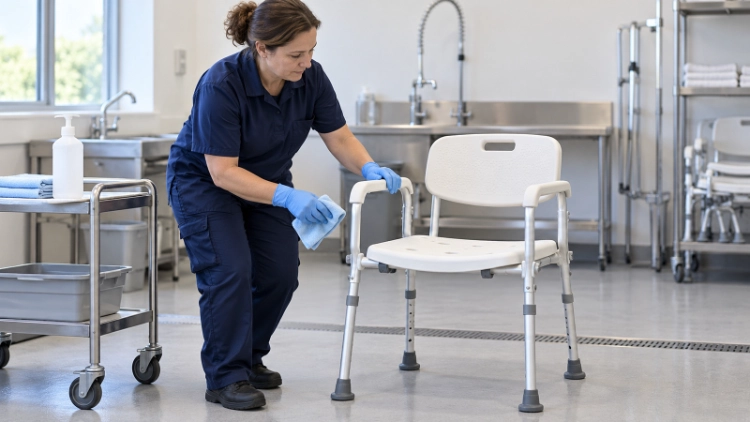
A shower chair can look ready for the next person while still holding water beneath the seat. A wipe across the upper surface will not reach every joint, and a clean frame can still have a loose armrest. In a shared bathroom, both problems belong in the handover between users.
Shower chair cleaning therefore needs a clear stopping point: the chair is clean, dry, checked and available for use. If one of those conditions is missing, staff need somewhere to put it while the problem is resolved. Leaving it beside the shower makes its status difficult for the next carer to judge.
Start with the instructions for that chair
The cleaning method has to suit the complete chair. An aluminium frame, a moulded seat and a padded surface may have different care requirements. A product’s suitability for use in a shower does not establish that every component can be immersed, exposed to steam or treated with the same chemical.
Before a new chair enters shared use, the person responsible for equipment should obtain its cleaning instructions. These should identify suitable products or methods, any restrictions, and what staff may remove. Where the instructions leave a gap, ask the supplier about the exact model and component. A general answer about aluminium chairs is insufficient for a cushion or a plastic joint.
Care settings also have their own infection prevention procedures. The Nottinghamshire Healthcare guidance on equipment decontamination places cleaning between patients alongside the manufacturer’s instructions and local arrangements. It offers a useful reference for organising the work; each facility still needs a method appropriate to its equipment and setting.
Give staff a usable instruction at the cleaning point
A manual stored in a purchasing folder is easy to miss during a busy shift. A short working instruction can identify the chair, refer to the approved cleaning procedure and explain where to report damage. It should also tell staff where the chair goes while drying. Protective equipment and handling of contaminated items belong to the facility’s procedure, rather than an improvised rule attached to the chair.
Work around the seat as well as across it
The visible seat is only part of the job. Its underside, the rear edge near the backrest and the points where supports meet the frame deserve attention. Armrest joints and height adjustment areas can also be awkward to reach. Staff should be able to access these surfaces without balancing the chair precariously or putting it down on an unclean floor.
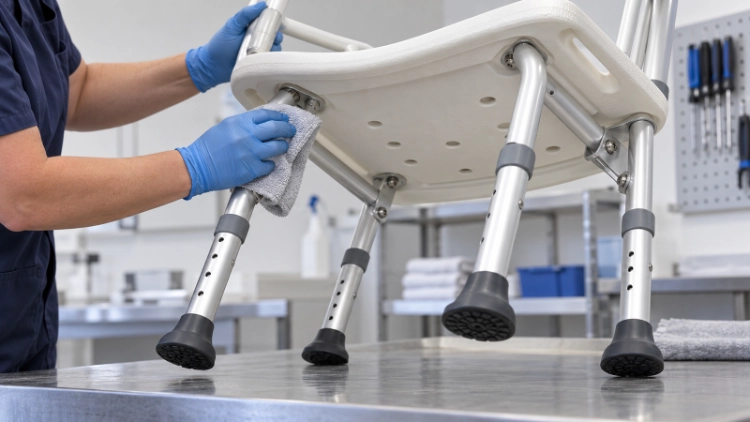
The time to discover an inaccessible area is before the purchase, ideally with a sample chair in the actual cleaning space. A catalogue photograph rarely reveals how easily a cloth reaches beneath a seat. If cleaning requires turning the chair, consider its weight, the available work surface and how staff will handle it safely when wet.
A padded model introduces another question. The XY798L shower seat combines an aluminium frame with a PE seat board and a soft cushion. That construction makes the cushion surface, its edges and its contact with the seat relevant to the cleaning review. It does not, by itself, establish that the cushion is removable or suitable for soaking.
If a component can be removed, the instructions should cover putting it back. Staff need to know how to recognise correct engagement, especially where a fitting is hidden beneath the seat. Removing parts simply to gain access can create a second problem if the chair returns to use with an unsecured component.
Leave room for drying and inspection
After the specified cleaning process, allow the chair to dry as directed. Check places where moisture may remain, including beneath the seat and around joints. Rinsing requirements depend on the approved method and cleaning product. Adding an extra rinse or omitting one should not be a matter of personal preference.
The storage arrangement matters here. A chair squeezed against a wall can be difficult to inspect, and equipment waiting to dry can easily be mistaken for equipment ready for use. Even a modest bathroom benefits from a defined position for cleaned equipment and a separate place for items awaiting attention.
A clean chair may still need to be held back
Inspection should follow the model’s maintenance instructions. Look for damage to the seat, movement at supports, loose fixings and deterioration of the feet. Where the chair has adjustable legs, check the permitted settings and the engagement of its adjustment mechanism. A damaged surface or joint may also make subsequent cleaning harder.
Remove a chair from use when a defect could affect safe support, and refer it to the responsible person. Tightening a fixing without knowing the correct assembly method or replacing a foot with something that happens to fit can obscure the original fault. The maintenance decision needs its own record; a completed cleaning entry cannot stand in for a repair.
Make the handover easy to read
An elaborate form is unlikely to help if staff cannot tell which chair it belongs to. The equipment identifier, completion time and responsible person are a practical starting point for a locally designed record. Facilities can add the information their procedures require without asking carers to rewrite the full cleaning method after every use.
Any tag or label used on the equipment should be suitable for the cleaning process and positioned away from the user’s contact surfaces and operating mechanisms. Its purpose is to make status clear. If staff see both a cleaning label and a fault report, the chair must not appear available merely because one task has been signed off.
When chairs move between bathrooms or departments, the identifier helps staff find the correct instructions and maintenance history. A purchase description such as shower chair with arms may cover several different models. Keep the supplier’s model reference alongside the facility’s equipment number, so a question about a cushion, fixing or replacement foot can be traced to the chair actually in front of the team.
This is also a useful question for a distributor supplying several bath chair models. Sending the same generic sheet with every chair leaves the care team to resolve the differences later.
For an order from Xunyu Medical, ask for the instructions that apply to each selected version, including padded and unpadded options. The customer may also need a way to identify replacement components without having to describe an unfamiliar fitting over the telephone.
Frequently Asked Questions
Can the same disinfectant be used on every shower chair?
Do not assume so. Compatibility depends on the chair’s components and the manufacturer’s instructions. A facility should confirm its proposed product and method for the exact model, including any padded parts, before adopting it as routine practice.
Does a removable seat make a chair easier to clean?
It may improve access, but removal and refitting add work. The important questions are whether removal is permitted, whether staff can do it safely, and how they verify that the seat is secure afterwards. A sample assessment is more useful than the feature description alone.
Should a chair be checked after every cleaning?
Build the relevant checks into the handover using the manufacturer’s instructions and the facility’s procedure. Cleaning gives staff an opportunity to notice damage, but it does not replace scheduled maintenance or a more detailed inspection when a fault is reported.
For a shared care setting, assess a sample chair through a complete cleaning and drying cycle before settling the order. Contact Xunyu Medical with the intended setting and proposed model to request the available care instructions and clarify component details. Those answers belong in the purchasing decision, while the chair is still being evaluated.


