

Using a Knee Scooter Indoors: Is Your Home Ready?
Time : Sep 24, 2026 View : 61

Using a knee scooter indoors can make short trips around a home easier after a clinician has approved the device, but the route and the product have to work together. Tight bathroom turns, thresholds, loose rugs, and a scooter that has been assembled differently after transport can all change control. For home-care suppliers and distributors, that matters as much as the model specification: the manual and after-sales guidance should help users check the route, the adjustment points, and when to stop. The device does not replace the user’s clinical weight-bearing plan.
Check the route before the first indoor trip
The most useful route is usually the one with the fewest surprises. Walk it first without the device and look beyond the first few metres. Loose rugs, charging cables, pet bowls, low stools, or a narrow turn can force a sudden correction. NHS falls-prevention guidance also recommends removing trip hazards such as wires and rugs and getting help with tasks that are difficult to reach or carry. The goal is not to empty the home. It is to make the main route repeatable.
Start with the trips that happen every day
List the short routes that are likely to repeat: bed to bathroom, sofa to kitchen, or bedroom to a stable chair. Keep frequently used items within reach at the destination so the user is not trying to carry a loose load while steering. A small bag or basket may be useful only when it does not block the handlebar, interfere with a control, or hide the front-wheel path.
Test doorways, thresholds, and turning space
A doorway can be wide enough for a straight pass and still leave too little room for the turn beyond it. Line up before the threshold, move at an unhurried pace, and check the surface on the other side. If the user has to twist hard, reverse repeatedly, or lean outside a stable position to clear the corner, the route should be changed or handled with trained assistance.
Keep lighting, footwear, and parking practical
Good lighting makes a dark threshold, cable, or wet patch easier to see. Secure footwear also matters when the user is stepping on and off the device. The parking point should be stable and out of the main walking line, with enough room around the handlebar and knee pad. A consistent parking place also helps caregivers notice if the scooter has been moved or adjusted since the last use.
Prepare the knee scooter before use
For the Knee Rollator-602 (XY-602), the assembly instructions use different fixing points for different parts. The rear wheel frame is opened and fixed with screws. The main frame is opened and the lever is locked. The front wheels are aligned, secured with a screw, and locked with the specified star bolt. The handlebar uses its own height setting, star bolt, and card buckle, while the knee pad is adjusted and secured at its tube. These details should not be reduced to one generic fastener rule.
Check adjustment points and fasteners
A quick hand check should cover the rear frame, front-wheel fittings, handlebar post, knee-pad tube, and visible fasteners. The XY-602 instructions also call for periodic checks for looseness, wear, or damage, with problems corrected before use. If a tube shifts, a fastener no longer seats, or a wheel fitting looks damaged, the unit should be held out of use until the problem is corrected with the specified part or service method.
Set height for the approved user
Handlebar and knee-pad height affect posture, reach, and sight lines, so they are not cosmetic settings. Adjust them only while the device is unloaded, align the holes, and secure the model-specific fastener. The product instructions show where the adjustment points are; a clinician or therapist remains responsible for the individual fit and weight-bearing plan.
Clean and store without creating another hazard
The XY-602 maintenance instructions call for a soft damp cloth and say not to use abrasive cleaners or caustic chemicals. When the unit is not used for a long period, it should be kept in a cool, dry, safe place. For daily home use, storage also needs to leave doorways, stairs, and common walking routes clear.
What should buyers support beyond the product itself?
A buyer comparing the Xunyu Medical walking aids range should look beyond frame material and load rating. Indoor-use questions often reach the distributor after delivery: which fastener belongs to which point, how the handlebar is adjusted, where the unit can be stored, or what to do when a wheel fitting feels loose. A clear manual, part identification, and a simple service route reduce guesswork for the user and the sales team.
Make the manual useful at the point of use
The most useful instructions show the adjustment points, the correct hardware, the locked position, and the conditions that require the user to stop. Product photographs should match the supplied configuration. If the quoted version changes, the manual and carton information should change with it. That is especially important for distributors carrying several walking-aid models with similar frames but different fittings.
Match the guidance to the channel
For distributors serving home-care, pharmacy, and rehabilitation channels in Malaysia, Singapore, or elsewhere in Southeast Asia, the same model may be used in very different interiors. Compact apartments, family homes, and rehabilitation rooms can create different turning and storage constraints. Guidance should therefore describe how to check the actual route rather than claiming that one footprint fits every home.
Use service records when the same problem repeats
Repeated reports of a loose fitting, damaged wheel, or confusing adjustment step should be recorded by model, batch or order reference, part, and photograph. That helps separate a one-off setup issue from a pattern that needs a supplier review. Xunyu Medical can then respond to a more precise question about the model, replacement part, or supplied instruction instead of treating every complaint as general user error.
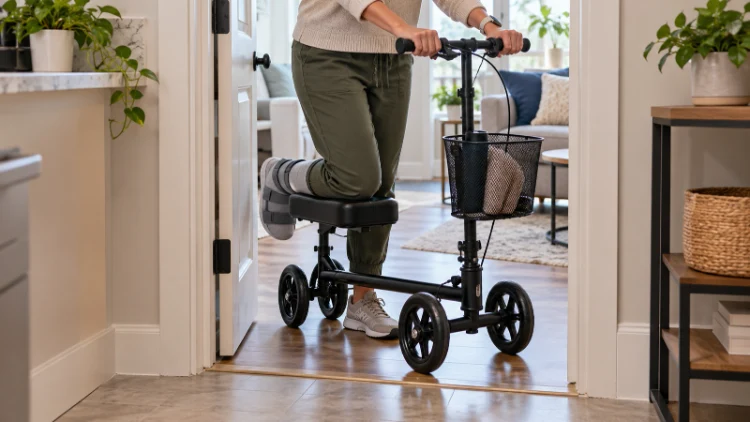
Use the home as a series of controlled stops
The first indoor sessions are better treated as short route checks. Prepare the destination before movement starts, keep both hands available for steering, and pause at a doorway or surface change. If the user has been told to have supervision, that support should be in place before the trip begins. A tidy floor does not make an unsuitable mobility aid appropriate for every injury.
Prepare the destination before moving
A stable chair, clear bathroom entrance, or prepared bedside area reduces the urge to rush at the end of the route. Keep loose objects off the path and place frequently used items where they can be reached after the user is safely stopped. Outdoor assumptions should stay separate: a route that works on smooth indoor flooring does not automatically make a wet slope, gravel path, or longer outdoor trip appropriate.
Know when to stop
Stop for a loose fastener, damaged wheel or frame part, blocked route, unexpected pain, dizziness, or loss of control. Sit or move to a stable position when possible and ask the appropriate caregiver or healthcare professional for help. Being close to the destination is not a reason to ignore a change in the device or the user’s condition.
Conclusion
Using a knee scooter indoors works best when the route, the device, and the user’s care plan are checked together. Clear the main path, test turns and thresholds, follow the XY-602 assembly and adjustment points, and record recurring product issues instead of improvising repairs. Buyers should also make sure that manuals, spare-part information, and service contacts match the supplied model. For a new order, replacement-part question, or channel-specific configuration, discuss the knee scooter requirement with the Xunyu Medical team before the specification is finalized.
FAQs
Q: Can a knee scooter be used in a small apartment?
A: It may be workable when the main route has enough space for controlled movement and turns do not force repeated reversing or unstable leaning. Test the real path at a slow pace and follow the user’s professional weight-bearing guidance.
Q: How often should the XY-602 be checked?
A: The product instructions call for periodic checks for looseness, wear, or damage and for problems to be corrected before use. Distributors should therefore keep the model instructions and service process clear and consistent for the end user.
Q: What should Southeast Asian distributors include in indoor-use guidance?
A: Include model-specific assembly points, adjustment steps, storage advice, part identification, and a clear stop-and-service rule. For compact homes or humid home-care settings, the guidance should stay practical and match the actual route and storage conditions.


