

What Happens When Solid Wheelchair Tires Develop Flat Spots
Time : Oct 20, 2026 Просмотр : 23
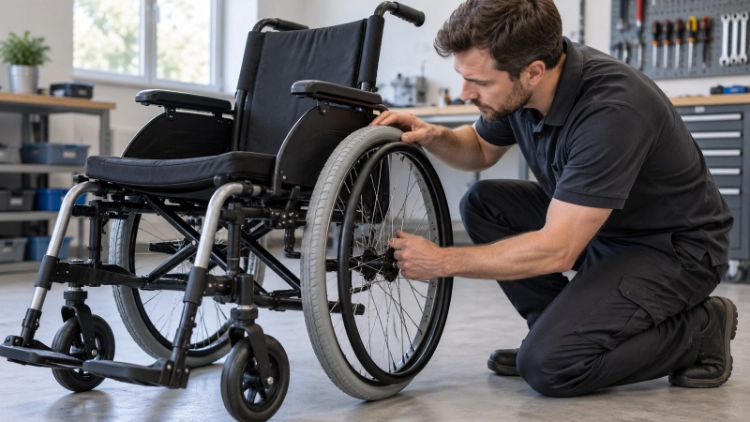
A regular bump on a smooth corridor can lead a carer to suspect a damaged wheelchair frame. Sometimes the change is at the tire: one area no longer follows the same circular profile as the rest. Solid wheelchair tire flat spots deserve a closer look, but a repeating vibration alone does not identify the cause.
A solid tire has no inflation pressure to restore. Inspection therefore needs to separate tire shape from rubbing brakes, loose bearings, debris and damage elsewhere in the wheel assembly. Replacing the first visibly worn part may leave the original complaint unresolved.
Start with the repeating symptom
A flat section creates a small change in wheel radius during each revolution. On a smooth corridor, the resulting vibration may repeat at a steady interval. The chair can feel less smooth, and loose parts may produce additional noise. The symptom may be harder to identify on rough paving because the surface already creates vibration.
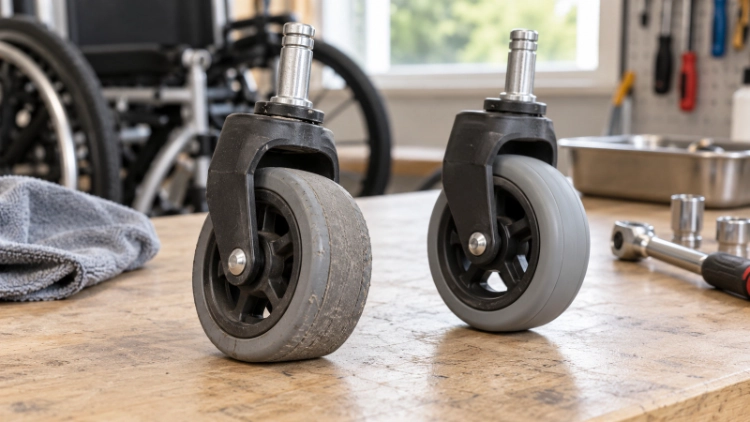
The impact depends on which wheel is affected. A rear-wheel flat spot may be felt through the seat or push handles. A front-caster problem can also influence steering and may resemble caster flutter, bearing damage, or debris caught around the axle. Inspection should include all wheels rather than replacing the first tire that looks unusual.
Ask whether the symptom began after storage, after wheel service or during ordinary use. Note whether it is present on every surface or mainly noticeable on a smooth floor. These observations help a technical team decide what to examine; they do not prove that the tire material has failed.
For a distributor handling a delivery complaint, a short video of a safely supported wheel rotating may show more than a close photograph. The method of supporting and inspecting the chair must follow its instructions. Do not use an occupied chair to reproduce an unsafe condition for the camera.
Separate a flat area from other wheel problems
A chair may also feel bumpy because the tire has worn more in one area. Wheel alignment, bearing condition, locked-wheel dragging, floor contamination, or a damaged hub can produce uneven wear. A visible flat area is therefore a symptom to investigate, not a complete diagnosis.
With the chair unoccupied and supported as permitted, inspect a complete revolution of the affected wheel. Watch both the tread profile and the movement of the hub or rim. A variation in the tire surface is a different observation from a wheel assembly that moves sideways. Record which part appears to change position.
Check for debris around the axle and contact with the brake or frame. If resistance occurs only at one point in a revolution, it needs investigation rather than an assumption that the tire has compressed. Bearing, hub and brake faults can coexist with worn tires.
Do not promise that the shape will recover
Some tire materials may show deformation after sustained loading, but the response depends on the compound, construction and storage conditions. Recovery time needs confirmation for the exact tire. A supplier should assess the part before anyone promises that ordinary use will remove the mark.
A local flat area may also result from wear, including dragging a locked wheel. That is different from reversible material compression. Photographs, use history and inspection of the contact surface help distinguish the possibilities. Describing every mark as storage deformation can hide a handling or brake problem.
В XY-809 manual wheelchair uses solid rear wheels, with solid front-wheel options identified separately. The tire format is relevant to this inspection, but it does not establish that every tire on the model has the same compound or behaviour. Any replacement must match the approved wheel configuration.
Decide whether the chair should remain available
A chair that is difficult to control, has visible wheel damage or shows insecure parts should be held out of use pending assessment. The decision should follow the equipment provider’s procedure. A mild reported vibration still deserves a recorded enquiry; it should not be dismissed simply because the tire cannot puncture.
Do not ask the customer to heat, cut, reshape, or modify the tire. Those actions can damage the product and erase evidence needed for supplier review.
For home-care distributors in Malaysia, the customer may describe the problem as noise or heavy pushing rather than a flat spot. Ask which wheel appears affected and what changed before the symptom began. Plain observations are more useful than asking the customer to diagnose the tire compound.
When seeking advice from Xunyu Медицинская, keep the order reference and photographs with the description of the symptom. Separate what is visible from what is suspected. A report that says periodic bump at the left rear wheel is more actionable than a claim that every tire in a batch is defective.
Connect receiving checks with storage conditions
Store the wheelchair in the conditions specified for the complete product. For the XY1001A, care instructions include a dry, ventilated and sheltered storage environment, away from corrosive substances. Those instructions protect the chair as a whole; they do not supply a temperature or time threshold for flat-spot formation on another model.
At receiving, compare the supplied wheel format with the approved configuration and look for damage before the equipment joins service stock. Any functional test load and acceptance method should be agreed for the product. Warehouse staff should not devise a loading test in response to a cosmetic mark.
The related article on wheelchair maintenance for long-term care can support a broader service routine. This particular complaint still needs its own wheel observations, especially if brakes or bearings were serviced shortly before it appeared.
If several units show similar marks on arrival, preserve the packaging information and the original condition for review. Compare affected wheel positions and shipment references before attributing the problem to one storage practice. A repeated pattern can guide an investigation without establishing the cause on its own.
Часто задаваемые вопросы
Q: Can solid wheelchair tires go flat?
A: Solid tires do not lose inflation pressure, but they can wear or develop changes in shape. A flat area should be assessed in the context of the tire material, wheel condition and use history. It should not automatically be treated as either harmless or a manufacturing defect.
Q: How can a flat spot be found during inspection?
A: Lift or unload the wheel as permitted, rotate it through a full turn, and watch the tire profile from the side and front. Check for repeated rise and fall, cracks, cuts, hub movement, and rubbing. Compare both sides and record the finding clearly.
Q: What information should be sent with a tire complaint?
A: Provide the wheelchair model, order or batch reference, affected wheel position, photos, a rotation video if possible, storage conditions, approximate use history, and a description of the symptom. This gives the supplier enough context to distinguish tire damage from brake, bearing, hub, or alignment problems.
For a recurring vibration or a suspected solid wheelchair tire flat spot, send the wheel observations for product review. Include the affected wheel position and a clear description of the repeating movement, without attempting to reshape the tire first.


