

Why Wheelchair Footrest Height and Angle Need Separate Checks
Time : Oct 28, 2026 Просмотры : 15

Wheelchair footrest height and footrest angle describe different settings. Height controls how far the footplate sits below the seat, while angle controls the orientation of the footplate or leg-support assembly. A footrest can be at the correct vertical distance but still place the foot at an unsuitable angle. It can also have a comfortable angle yet sit too low for ground clearance or too high for lower-leg support.
Buyers should therefore avoid one checklist item called adjustable footrest. The specification needs to state what adjusts, through which range, how it locks, and whether the parts are removable, swing-away, fixed, or elevating. Individual setup should be handled through an appropriate fitting process.
Height Supports the Lower Leg
The Setting Relates to Lower-Leg Length
Footrest height determines the distance between the seat and the footplate. If the support is too high, the knees may be raised and pressure distribution across the seat can change. If it is too low, the feet may lack support or the front of the thighs may carry more load. The correct position depends on the user, cushion, footwear, seat height, and clinical needs.
В WHO Wheelchair provision guidelines connect assessment, fitting, training, and follow-up. That boundary is important for suppliers. A product sheet can describe the adjustment range, but it should not prescribe one universal setting for every user.
Height Also Affects Ground Clearance
Lowering the footplates reduces clearance above the floor. They may contact ramps, thresholds, or uneven ground if set too low. Raising them for clearance without considering leg support can create another problem. This is why route conditions and fitting need to be considered together.
Some manual wheelchair models have detachable footrest assemblies with multiple locking positions and screw-based height adjustment. Seat depths and wheel sizes also vary by model, so buyers should confirm the footrest adjustment system against the exact configuration before comparing similar-looking chairs.
Angle Changes the Position of the Foot and Leg
Standard Footplates and Elevating Leg Supports Serve Different Roles
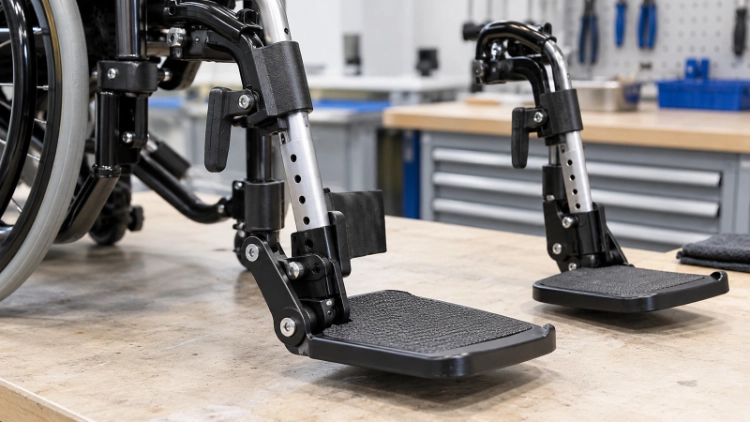
A standard footrest commonly supports the foot below the front of the seat, often with a hanger angle fixed by the chair design. An elevating leg support changes the angle of the lower-leg assembly and may include calf support. Swing-away or detachable features describe movement for access or transport, not the same adjustment as elevation.
Buyers should use precise terms. A removable footrest is not automatically angle-adjustable. A footplate that flips upward for transfers does not necessarily change the hanger angle. Product photos can hide these distinctions.
В Категория медицинских инвалидных колясок Сюнью includes manual and multifunction formats with different leg-support structures. A product listing may mention an adjustable-angle or height footrest for a particular model, but the exact model manual should define each movement, adjustment range, and lock.
Footplate Angle Is a Separate Detail
Some footplates allow their surface angle to be adjusted relative to the support tube. This can help accommodate footwear or positioning requirements when the design permits it. Other footplates have a fixed surface. The buyer should not assume adjustability from a slotted bracket or visible bolt without confirmation.
Angle hardware needs secure locking. A plate that slowly rotates under load can change foot position and clearance. Sample approval should include a visual check of the adjustment mechanism and the manufacturer’s functional test.
Footrests Affect Transfers and Handling
The XY-809 manual-wheelchair instructions warn users not to stand on the foot pedals when getting into or out of that chair. This safety point should be checked against the manual for the exact quoted model rather than applied as a universal statement about every wheelchair. A wheelchair can tip when body weight is applied far in front of the main wheels. Footplates should be folded, swung aside, or removed as instructed before a transfer when the design allows.
This is also why footrests should not be used as lifting handles. Many assemblies are movable and held by release mechanisms. Lifting a wheelchair by them can damage the part or allow it to detach. Staff should grasp only the frame locations identified in the product instructions.
Detachable footrests can reduce packaging volume and simplify storage, but they create matching and packing tasks. Left and right assemblies may not be interchangeable. A bulk-order checklist should confirm quantity, side, model code, finish, adjustment hardware, locking action, and packaging protection.
В XY-809 manual wheelchair shows how a model page can combine footrest, wheel, brake, frame, and dimension information. Buyers should still request the latest technical drawing for the configuration under review.
What Buyers Should Inspect
Check both sides for matching parts and smooth attachment. Swing the assemblies away or remove them only as the manual permits. Confirm that release levers return, locking pins engage, and the footrests do not detach under the approved pull check. Fold-up footplates should move without excessive play or sharp contact.
Next, check the height-adjustment range and method. Record the reference points used for measurement. Confirm that fasteners can be secured without damaging the tube and that any holes or indexed positions align correctly. Do not approve a range based only on the number of visible holes; measure it.
For angle-adjustable parts, check the stated range, left-right consistency, locking hardware, and clearance from casters and the floor. Turn the front casters through their operating arc to identify interference. Verify that the chair can fold as intended with the footrests in the approved transport position.
Documentation should show installation, adjustment, transfer position, cleaning, inspection, and replacement-part identity. Buyers can use the broader Xunyu Medical product catalogue to compare configurations, but fitting decisions and safe settings remain model- and user-specific.
Pair detached footrests with the correct frame. Label left and right parts, protect release levers, and check quantities. Record missing hardware separately from fit concerns. For bulk receiving, record the chair model, left and right footrest codes, included hardware, and any mismatch before releasing stock.
Часто задаваемые вопросы
Q: Is wheelchair footrest height the same as seat-to-floor height?
А: No. Seat-to-floor height measures the seat’s position above the ground. Footrest height usually describes the distance from the seat area to the footplate or the adjustment position of the hanger. Both measurements affect lower-leg support and clearance.
Q: Should wheelchair footplates be level?
А: Some are fixed near level, while others permit angle adjustment. The appropriate position depends on the product design and individual fitting. Buyers should confirm the stated adjustment range and locking method rather than applying one angle to every wheelchair.
Q: Can a person stand on wheelchair footrests during a transfer?
А: Footrests are generally not intended as steps. Loading them can tip the wheelchair forward or damage the assembly. Transfers should follow the wheelchair instructions and the guidance of the responsible professional, with footplates moved out of the way when appropriate.
Q: Why do wheelchair footrests touch the floor?
А: They may be adjusted too low, installed incorrectly, bent, loose, or unsuitable for the chair configuration. Low seat height, caster position, ramps, and uneven surfaces can also reduce clearance. The chair should be inspected before further use.
Q: What footrest details should appear in a supplier quotation?
А: State fixed, swing-away, detachable, elevating, or other type; height and angle adjustment ranges; footplate material; calf support where supplied; left and right part codes; locking method; transport position; included hardware; and compatibility with the quoted wheelchair model.
Height and angle should be checked separately for support and clearance. For model-specific adjustment ranges, locking methods, and replacement parts, contact Xunyu Медицинская.


