

How to Choose a Wheelchair for an Older Adult at Home
Time : Sep 03, 2026 Ansicht : 12

A wheelchair can fit the user and still be awkward at home. One may feel fine during a short trial but become tiring when it has to turn beside a bed, move under a table, or go in and out of a car several times a week.
For daily home use, the choice should start with the person and the routine around the chair. Who will push it? Can the user propel independently? Who operates the parking brakes and footrests? How long will the user sit in the chair each day?
A therapist or healthcare professional should assess posture, pressure risk, transfers, and medical suitability. The checks below help families judge whether a wheelchair will work in everyday life.
Start With How the Wheelchair Will Be Used
Not every older adult uses a wheelchair in the same way.
Some people walk short distances at home and use the chair mainly for clinic visits or longer outings. Folding, lifting, and car storage may matter most.
Others spend much of the day in the chair. Seat comfort, posture, brake access, footrest position, and ease of moving around the home become more important.
There is also a big difference between self-propelled and caregiver-pushed use. A person with enough upper-body strength may want large rear handrims and room to move independently. Someone who relies on a family member or aide may care more about push handles, caregiver brake access, and manageable lifting weight.
Before comparing models, write down what the chair needs to do during a normal week. That list often narrows the choice faster than a long specification sheet.
Check Seat Fit Before Choosing a Smaller Chair
A compact frame can help at home, but making the chair smaller at the expense of the user is a poor trade.
Seat width should give enough room without excessive pressure at the hips. Too much space can also be a problem because the body may slide sideways and the arms may have to reach farther for the handrims.
Seat depth, back height, and seat-to-floor height affect posture and transfers. A cushion changes the final sitting position, so measurements should reflect the cushion and clothing used every day.
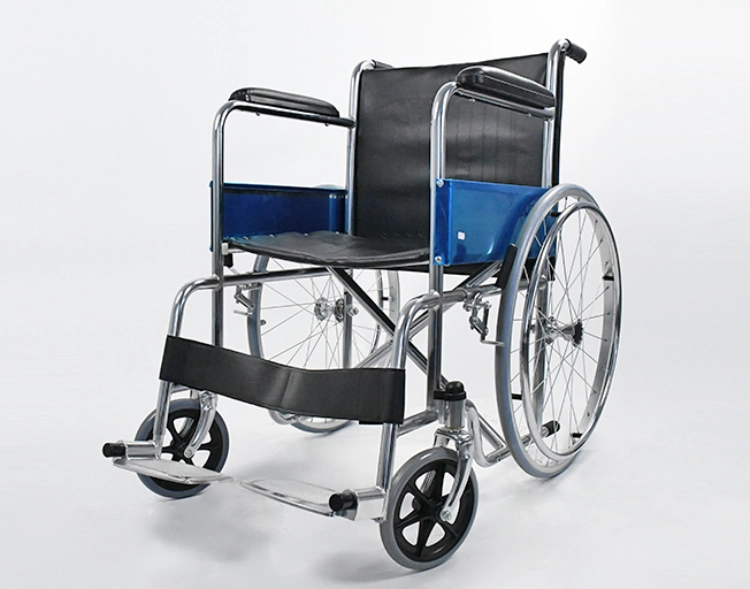
Footrests should support the legs without dragging on the floor. Swing-away or detachable designs can make transfers and table access easier. Arm supports matter too. Fixed, removable, and flip-back designs suit different transfer routines.
Decide Who Controls the Chair
This point can change the whole setup.
A self-propelled user needs to reach the rear handrims comfortably and control the chair without twisting or overreaching. A caregiver-pushed chair puts more work on the person behind it, so push-handle height, brake access, and footrest position become practical concerns.
Some families need both. The user may move independently indoors but rely on help for longer trips.
Xunyu Medical’s XY-908 shows how one setup can cover both roles. Its 24-inch rear wheel can be removed for a nursing mode and installed again for self-use. Rear flip armrests and detachable footrests also affect transfers and storage.
More adjustability is useful only when it matches the routine.
Treat Parking Brakes as Parking Brakes
Manual wheelchair brakes are there to keep the chair still. They should not be treated like bicycle or car brakes for slowing a moving wheelchair.
Before a transfer, move the chair onto the flattest practical surface, set both parking brakes, and check that the frame stays in place. If one side slips or releases, stop using the chair for that transfer until the brake is checked.
Footrests should be moved out of the transfer path where the design allows. They support the legs while seated; they are not steps. Standing on a foot pedal can tip the chair forward.
Check the Home, but Do Not Choose by Doorway Width Alone
The chair still has to fit the route. Check the narrowest doorway, tight turns, lift access, bedside space, and raised thresholds.
Do not confuse seat width with overall wheelchair width. Rear wheels, handrims, frame tubes, and brake parts can make the full chair much wider than the seat.
Xunyu Medical’s separate guide, Wie man die Abmessungen eines Rollstuhls für Türöffnungen und Wege im Haus misst, covers doorway clearance, turning space, thresholds, and route measurements in more detail.
For this article, the more useful question is what happens after the chair fits through the door. Can it approach the bed? Can the caregiver turn without twisting? Do the footrests hit furniture? Can the user get close enough to the dining table?
Passing through the opening is only the first part of home use.
Think About Folding, Carrying, and Storage
A folding wheelchair is convenient only when the people handling it can use the folding system comfortably.
Open and close the frame on level ground and keep fingers away from cross-braces and moving joints. The frame should reach its normal open position without being forced. A new gap, bent brace, uneven fold, or sudden stiffness deserves attention.
For families who use a car, test the real handling routine. Can the usual caregiver lift the chair into the boot? Does a footrest or rear wheel need to come off first?
A lightweight wheelchair can still be bulky. A narrow-folding wheelchair can still be heavy. Folded size and handling weight are separate questions.
Clean the Chair Without Damaging It
Daily-use wheelchairs pick up dust, moisture, food residue, and dirt from outdoor wheels.
Where the material permits, use a soft cloth with diluted neutral detergent, wipe away the residue, and dry the surfaces. Avoid high-pressure water, steam, volatile solvents, and abrasive cleaners that can damage finishes or plastic parts.
Dry the seat and back pad promptly if they become damp. Check the moving joints, wheel surfaces, brakes, and footrest fittings while cleaning.
Shared wheelchairs may need a more specific cleaning and disinfection routine. Product instructions and professional guidance should take priority when contamination goes beyond normal household use.
Give the Wheelchair a Short Home Trial
A short, supervised trial can reveal problems that are hard to see in a catalogue.
Use the cushion, clothing, and shoes that will be part of normal use. Move through a typical route. Approach the bed and table. Set the brakes. Move the footrests. Fold the chair and put it where it will actually be stored.
Watch the caregiver too. Is there enough room behind the chair? Do the handles hit a wall? Does the caregiver have to twist sharply to turn? Can the user see the path ahead without leaning forward?
Do not use stairs or steep slopes as a test area for a new chair. The point is to find ordinary handling problems in a controlled setting.
Families can compare different configurations through the Xunyu Medical wheelchair range and use the contact team for model-specific dimensions or parts before making a final choice.
More elderly mobility guidance and products are available on Xunyu Medizinische.
Schlussfolgerung
A wheelchair for everyday home use has to fit more than the doorway.
Seat fit, footrests, arm supports, brakes, who controls the chair, how it folds, and who has to lift it all shape the daily experience. A compact model may be convenient for one family and frustrating for another.
The better choice is the chair that works with the user’s body, the caregiver’s routine, and the places it needs to go. A short home trial, when possible, can reveal more than another page of features.
Häufig gestellte Fragen
Q1: How should wheelchair seat width be chosen?
A1: Measure the seated user in normal clothing and consider the cushion, posture, and side support. A seat that is too narrow can create pressure, while too much space can reduce control. A therapist should confirm the fit when medical or postural support is needed.
Q2: Can a caregiver push any manual wheelchair indoors?
A2: Not every chair suits every home or caregiver. Push handles, brakes, footrests, overall size, wheel setup, and the route through the home all matter. A short supervised trial is useful before making the chair part of the daily routine.
Q3: Can someone stand on the footrests to get into a wheelchair?
A3: No. Footrests are designed to support the legs while seated, not to act as steps. Move or remove them for the transfer when the chair design and the user’s care plan allow it.


